

Find your dance connection
On udansa, you will find dance enthusiasts who understand Kizomba not just as a sequence of steps, but as a vibrant culture they want to experience together with you.

By Mary De LucaUpdated

On udansa, you will find dance enthusiasts who understand Kizomba not just as a sequence of steps, but as a vibrant culture they want to experience together with you.
Kizomba is much more than just a partner dance with close movements. It is the pulsating heart of Angolan society and an expression of joie de vivre that connects generations.
Kizomba is an Angolan partner dance and musical style that emerged in Luanda in the 1980s. The word comes from the Kimbundu language and means party or social gathering.
In western dance schools, Kizomba is often taught as a highly sensual, almost intimate partner dance. In Luanda, the capital of Angola, the reality is completely different. There, Kizomba is primarily a family dance. At birthdays, weddings, and neighborhood parties, all generations dance together: the grandson with the grandmother, uncles with nieces, and friends among themselves. It is not about seduction, but about community and celebrating the moment. Angolan dance culture is deeply rooted in this social fabric, where dancing is as much a part of everyday life as eating together.
If you want to understand the true Kizomba traditions, you must move away from a purely technical perspective. In Angola, you do not learn this dance in sterile studios with mirrored walls, but by watching and imitating from childhood on. The dance is an integral part of social life and serves as a link in society. If you want to engage more intensively with the roots, it is worth taking a look at the Kizomba history, which describes the path from a local phenomenon to a global trend.
The original etiquette of Kizomba in Angola differs drastically from the rules that apply at European socials today. While an artificial distance or, conversely, a forced intimacy often prevails in the West, dancing in Angola is based on natural respect and a clear, yet relaxed distribution of roles. You dance close because the space at crowded courtyard parties requires it, not to send a romantic message. The physical closeness is completely platonic and characterized by mutual respect.
A central aspect of Angolan dance culture is simplicity and the connection to the music. It is not about standing out with complicated figures or dominating the floor with expansive steps. Anyone wanting to shine at a party in Luanda does so through a sense of rhythm, composure, and the ability to adapt perfectly to the partner and the music. If you want to learn the basics of this dance, starting with Kizomba steps will help you get a feel for the movement.
Traditional Angolan
Western cliché
Kizomba is not a dance you learn in a studio to perform. It is a feeling you learn from family to celebrate life together.
The transfer of Kizomba to the Western world has led to a noticeable shift in values. In European dance schools, standardization is often the focus: steps are counted, figures are cataloged, and dance styles are strictly separated from one another. In the process, the lightness and improvisation that define Kizomba in its homeland are often lost. In Angola, you do not count, you feel. The dance adapts to the mood of the music and the energy of the room.
Furthermore, commercialization in the West has led to Kizomba often being sexualized, which contradicts the family-oriented nature of Angolan traditions. If you want to grasp Kizomba in its depth, you should try to discard these Western filters and engage with the original idea: a respectful, grounded connection between two people moving together to the music. You can find a good overview of the variety and how to get started with this fascinating partner dance in the comprehensive guide on learning to dance Kizomba.
Kizomba as a social glue in Angola
In Angola, Kizomba is an integral part of everyday life. People dance at family gatherings in the backyard, improvise to the music, and share the moment with all generations without any pressure to perform.
The European interpretation of dance
In Western dance schools, fixed sequences of steps, technical training, and a strong focus on sensuality in a club context often dominate.
The word Kizomba comes from the Angolan language Kimbundu and means feast, party, or social gathering. It perfectly describes the social character of the dance.
In Angola, all generations dance Kizomba together at family celebrations and weddings. In the West, however, the dance is mostly practiced in clubs and dance schools by young adults as a purely sensual partner dance.
No, Kizomba is a platonic family dance in Angola. The close body posture originally resulted from a lack of space at private parties and is a sign of familiarity and respect, not romance.
Find the right course and learn to love Kizomba from the ground up.
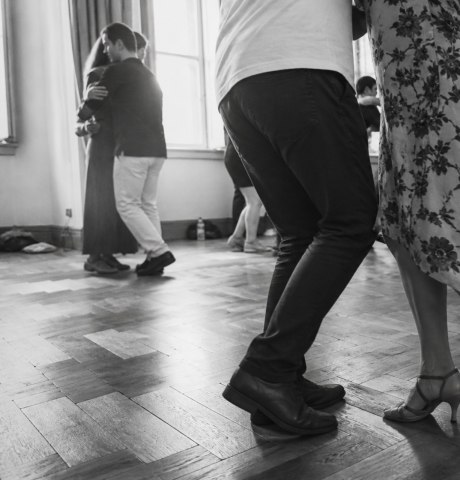 The history of Kizomba: From its Angolan roots to a global danceDive into the history of Kizomba. Learn how Angolan traditions and Caribbean beats combined to create a global dance phenomenon.
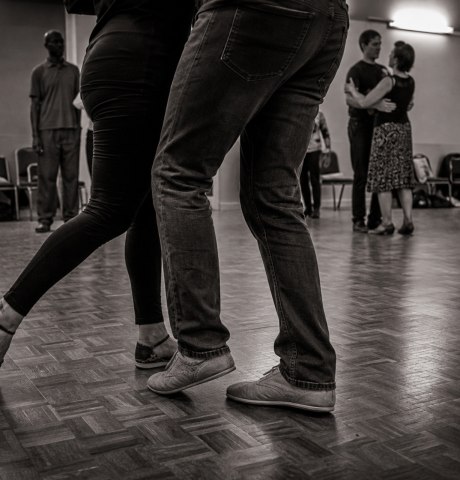 Learn Kizomba steps: An easy start for beginnersGetting started is easy: With our practical guide, you will learn the most important Kizomba basic steps and the correct posture for a harmonious dance experience.
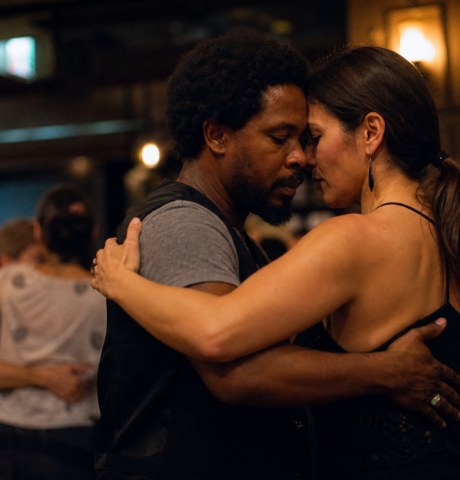 Learn to dance Kizomba: The guide to the partner danceKizomba combines African rhythms with a deep, emotional connection in partner dance. Learn how to master this fascinating dance style from scratch.The history of Kizomba: From its Angolan roots to a global danceDive into the history of Kizomba. Learn how Angolan traditions and Caribbean beats combined to create a global dance phenomenon.
 Kizomba in Europe: How the dance conquered the continentKizomba conquered all of Europe from Portugal and France. Discover how this sensual partner dance spread across the continent and which styles emerged from it.
 The history of Tarraxo: Origins and distinctionsLearn how the urban dance and music style Tarraxo developed in Europe and how it fundamentally differs from traditional Tarraxinha.
 Zouk vs. Kizomba Rhythm: A Music ComparisonZouk and Kizomba share common roots, but they sound completely different on the dance floor. This guide analyzes their rhythmic structures and shows you how to instantly distinguish the beats.
 Kizomba and Brazilian Zouk: Two historical pathsKizomba and Brazilian Zouk share rhythmic roots, but they evolved on completely different continents. This guide explores the fascinating paths of both dances.
 Semba and Kizomba: The difference in music and danceDiscover the subtle difference between Semba and Kizomba. We explain how the music defines the dance feeling and movement on the dance floor.
 Understanding Kizomba music: How to hear the rhythmKizomba music has a very special magic. Learn here how to effortlessly pick out the characteristic beat and instruments so you can fully surrender to the music.