

Find your Kizomba partner on udansa
On udansa you find like-minded people who share your passion, as well as suitable courses in your area to deepen your steps on the dance floor.

By Mary De LucaUpdated

On udansa you find like-minded people who share your passion, as well as suitable courses in your area to deepen your steps on the dance floor.
Kizomba has been on an impressive journey over the last few decades. Learn how the Angolan partner dance conquered European dance floors via Portugal and France and became a permanent fixture.
Kizomba in Europe refers to the development, spread, and stylistic evolution of the Angolan partner dance Kizomba on the European continent since the late 1980s. The term encompasses both the preservation of traditional roots and the emergence of new, European-influenced dance styles.
The European success story of Kizomba did not begin in the continent's major metropolises, but in the living rooms and small neighborhood gatherings of the African diaspora. In the late 1980s and 1990s, immigrants from Angola, Cape Verde, and Guinea-Bissau brought their music and dances with them to Portugal. Lisbon became the logical gateway for Kizomba in Europe. In the suburbs of the Portuguese capital, the traditional sounds of their homeland blended with the influences of European club culture. People met here to preserve a piece of home, but the infectious energy of the dance did not remain unnoticed for long.
A vibrant club scene quickly developed from these private circles. The first Portuguese DJs began playing the typical rhythms, and dance enthusiasts outside the African community became curious about this close, emotional partner dance. Back then, anyone who wanted to understand the basics had to learn directly from the pioneers, who taught the dance without a fixed textbook, but purely by feeling. This organic spread of Kizomba laid the foundation for a movement that would sweep across all of Europe just a few years later.
While Portugal was the cradle of the European scene, France acted as a powerful catalyst. The great Kizomba boom in France began around 2010 and permanently changed the European dance landscape. French dancers, often with a background in Hip-Hop or Salsa, took the Angolan foundations and began to cross them with new elements. They changed the dance posture, made the steps more linear, and incorporated complex footwork. This development was the starting signal for a new era and eventually led to the emergence of modern offshoots like Urban Kiz.
France became the epicenter for international teachers and DJs. From Paris, the phenomenon spread like wildfire across the entire continent. The French scene professionalized instruction and made Kizomba accessible to a wide audience in Europe. Anyone who wants to learn Kizomba steps today benefits directly from the didactic structures that were developed in France and neighboring countries during this boom phase.
Correct
Wrong
In Europe, Kizomba has built a bridge between different cultures and shows how music and movement can connect people without words.
Today, Kizomba is an indispensable part of the European dance scene. From its beginnings in Lisbon and Paris, the dance has spread to the north and east of Europe. Every major city now has its own community. The history of Kizomba in Europe shows how an exclusive cultural import has become a connecting element of European dance culture. In the process, a fascinating diversity has developed: while the traditional Angolan style is at the forefront in some regions, other communities prefer modern, fused variations.
This coexistence of different styles ensures constant dynamics. Anyone who delves deeper into the subject and engages with Kizomba Body Movement will quickly realize how multifaceted this dance has become on European soil. The journey that began in the suburbs of Lisbon has turned Kizomba into a global phenomenon that connects people across all linguistic and cultural boundaries.
The Angolan origin in Europe
The traditional style places great importance on circular movement, grounding, and the close connection within the pair. It preserves the cultural roots and the family etiquette of Angola.
The European evolution of dance
The modern development emphasizes linear footwork, syncopation, and influences from Hip-Hop. It emerged significantly during the boom in France and Western Europe.
The dance arrived in Europe in the late 1980s and early 1990s. Primarily, immigrants from Angola and other Portuguese-speaking African countries brought the rhythm to Portugal, from where it spread further.
Portugal is considered the most important pioneer country, as Lisbon was the first major hub for the African diaspora. Later, France played a decisive role in the modernization and rapid spread across the entire continent.
In Europe, people dance both traditional Kizomba from Angola and modern developments like Urban Kiz. While the traditional style is very soft and circular, modern European styles are often characterized by linear steps and changes in tempo.
Find the right course and learn the steps of this fascinating dance right in your area.
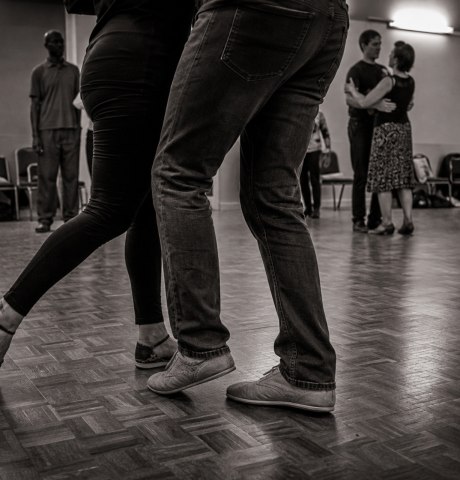 Learn Kizomba steps: An easy start for beginnersGetting started is easy: With our practical guide, you will learn the most important Kizomba basic steps and the correct posture for a harmonious dance experience.
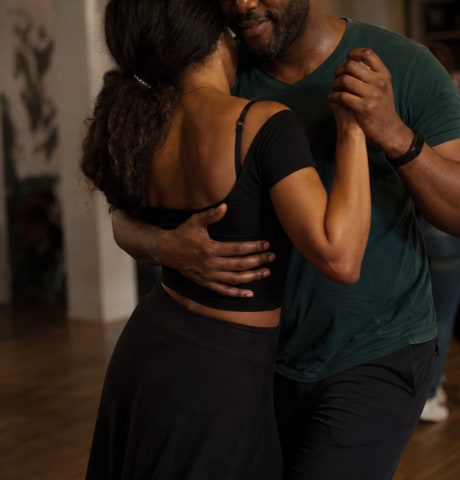 Kizomba Body Movement: Styling for Advanced DancersTake your Kizomba to the next level. Learn how to add more feeling to your dance with subtle body movement, precise Tarraxinha technique, and elegant improvisation.
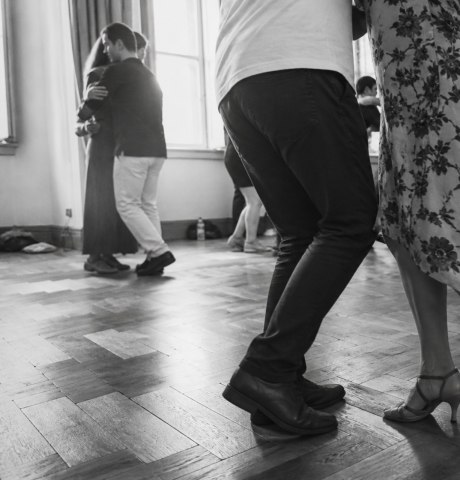 The history of Kizomba: From its Angolan roots to a global danceDive into the history of Kizomba. Learn how Angolan traditions and Caribbean beats combined to create a global dance phenomenon.
 The history of Tarraxo: Origins and distinctionsLearn how the urban dance and music style Tarraxo developed in Europe and how it fundamentally differs from traditional Tarraxinha.
 Zouk vs. Kizomba Rhythm: A Music ComparisonZouk and Kizomba share common roots, but they sound completely different on the dance floor. This guide analyzes their rhythmic structures and shows you how to instantly distinguish the beats.
 Kizomba and Brazilian Zouk: Two historical pathsKizomba and Brazilian Zouk share rhythmic roots, but they evolved on completely different continents. This guide explores the fascinating paths of both dances.
 Semba and Kizomba: The difference in music and danceDiscover the subtle difference between Semba and Kizomba. We explain how the music defines the dance feeling and movement on the dance floor.
 Understanding Kizomba music: How to hear the rhythmKizomba music has a very special magic. Learn here how to effortlessly pick out the characteristic beat and instruments so you can fully surrender to the music.
 The 5 most important Kizomba music styles comparedDiscover the fascinating variety of Kizomba music: From traditional Semba to the modern Ghetto Zouk beat, we explain the five most important music styles.