
Find your dance community online
On udansa you will find like-minded people who share your passion for rhythm, culture, and movement. Meet dance enthusiasts in your area and dive into the world of traditional and modern dances together.



By Mary De LucaUpdated
On udansa you will find like-minded people who share your passion for rhythm, culture, and movement. Meet dance enthusiasts in your area and dive into the world of traditional and modern dances together.
Deep in the northeast of Brazil, in the state of Bahia, lies the origin of a rhythm that moves the whole world today. The samba de roda history begins in the 17th century in the Recôncavo Baiano, a fertile region around the All Saints' Bay. Here, the musical traditions of abducted African slaves, especially the Bantu cultures, merged with Portuguese influences such as round singing and poetry. In contrast to today's fast-paced carnival dance from Rio de Janeiro, the Samba de Roda is a ritualistic, deeply communal circle dance. It was celebrated after hard field work on the sugar cane plantations to preserve identity, find comfort, and resist. The circular formation symbolizes equality and cohesion, as there is no fixed stage and every participant takes turns in the center of the action.
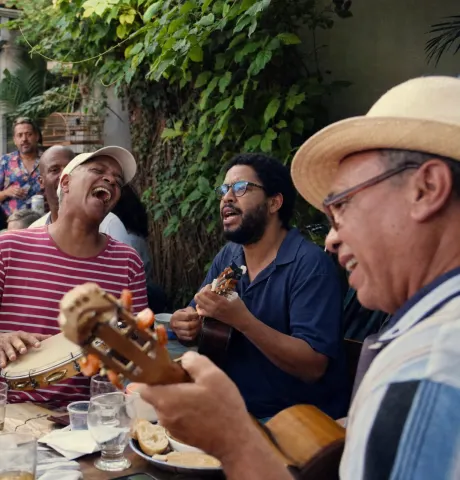
The music is carried by traditional instruments, above all the atabaque drum, the pandeiro, and the characteristic prato-e-faca (plate and knife), which weave a dense, hypnotic tapestry. The singing works on the call-and-response principle, where a soloist leads and the community answers in chorus. Whoever enters the circle usually dances solo and improvises with earthy, flat steps that maintain a deep connection to the ground. This historical form of expression is so significant for the cultural heritage of humanity that it was recognized by UNESCO in 2005 as a Masterpiece of the Oral and Intangible Heritage of Humanity. To this day, the traditional samba circle dance has remained alive in Bahia and forms the foundation upon which later styles like Samba no Pé were able to develop.

The musicians and participants stand in a tight circle. This formation symbolizes equality, creates a protected space for the dancers, and focuses the energy of the entire group.
The musicians set the rhythm with pandeiro, atabaque, and the clinking of plates and knives. The lead singer begins a verse, and the entire roda responds in traditional call-and-response singing.
A single person, often a woman in traditional clothing, steps into the center of the circle. She dances with fast, earthy steps and improvises freely to the music, while the roda cheers her on.
To make room for the next dancer, the person in the middle gently nudges a spectator with their hip. This traditional gesture, the Umbigada, is the invitation to switch.
Samba de Roda originated in the 17th century in the Recôncavo Baiano in Bahia. Enslaved Africans combined their religious and musical traditions with Portuguese elements to create this unique circle dance.
At the center is the circle (Roda), where usually only one person dances while the others clap and sing. The music is performed live with pandeiro, atabaque, and vocals, with dancers being replaced by a symbolic nudge (umbigada).
Yes, in 2005, UNESCO declared the Samba de Roda de Bahia a Masterpiece of the Oral and Intangible Heritage of Humanity. This award recognizes its role as the historical cradle of Brazilian identity.
Discover the variety of Latin American rhythms and find the right course for you.
BallroomMeißen · Germany
Tanzkreis | PROFESSIONALTuesday · 20:15 · Oct 27, 2026 - Jan 5, 2027
“Ein Haus für Vieles” - Saal Tanzkurse
BallroomMeißen · Germany
Fortgeschrittenen-Kurs | ADVANCEDTuesday · 18:30 · Nov 10, 2026 - Jan 19, 2027
“Ein Haus für Vieles” - Saal Tanzkurse
BallroomMeißen · Germany
Tanzkreis | PROFESSIONALThursday · 19:20 · Jan 7 - Mar 25, 2027
"Atelier Federleicht" - Saal Tanzkurse
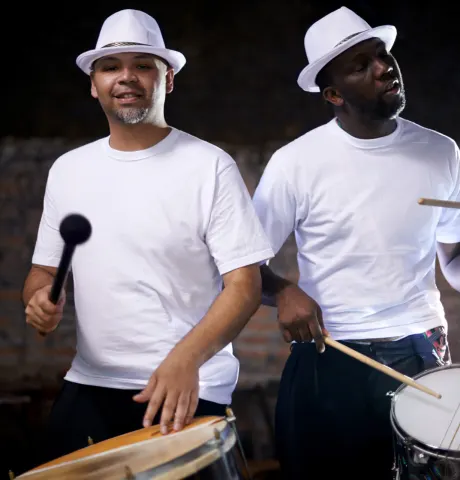 Samba instruments: The sound of the bateria in detailDive into the fascinating world of Brazilian samba instruments. Learn how the surdo, tamborim, and others shape the unmistakable sound of the bateria.
 History of Samba: The roots of the Brazilian heartbeatThe history of Samba is a journey full of rhythm, culture, and resistance. Discover the fascinating African roots and the instruments that shaped this global success.History of Samba: The roots of the Brazilian heartbeatThe history of Samba is a journey full of rhythm, culture, and resistance. Discover the fascinating African roots and the instruments that shaped this global success.
 Samba Roda structure: How to host a traditional sessionLearn how to structure a traditional Samba Roda musically, which unwritten laws apply within the circle, and what the perfect session flow looks like.
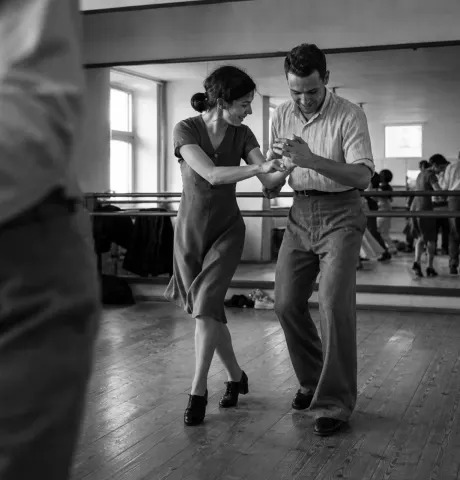 History of Samba in Europe: The Journey Across the OceanThe journey of Samba from the streets of Rio to European ballrooms is a story full of fascination, misunderstandings, and cultural adaptation. Learn how the rhythm conquered Europe.Samba instruments: The sound of the bateria in detailDive into the fascinating world of Brazilian samba instruments. Learn how the surdo, tamborim, and others shape the unmistakable sound of the bateria.
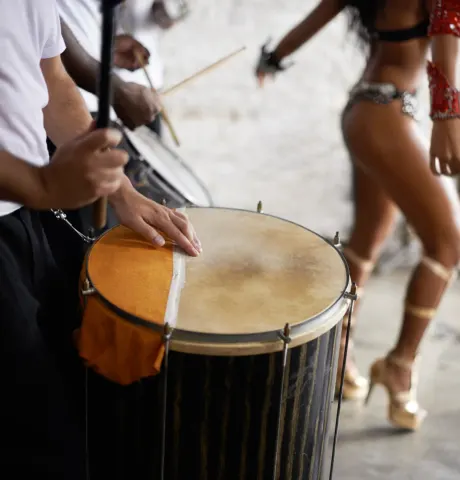 Counting Samba rhythm: How to hear the beatLearn step by step how to identify the Samba rhythm flawlessly and count the beat like a pro. No dance steps required, just for your ears.
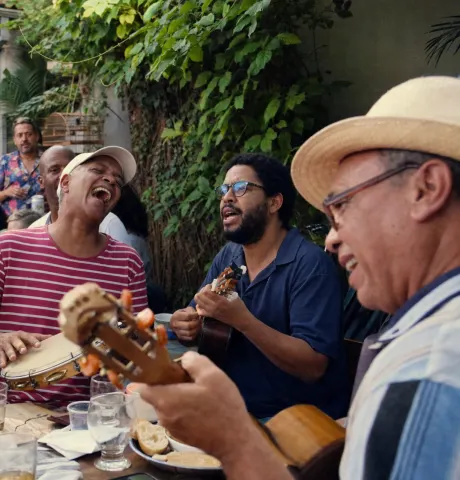 Samba music styles: From Pagode to Bossa NovaSamba is not just samba. Our guide leads you through the fascinating world of samba music styles, from wild Samba Enredo to elegant Bossa Nova.
 Which Samba style suits you? Take the testFind out which Samba subgenre best matches your musical taste with our quick test. Discover the variety from Bossa Nova to Pagode!