Understand ballet together
On udansa connect, you’ll find people in London to share your impressions of dance performances with or attend a ballet class.

By Mary De LucaUpdated
On udansa connect, you’ll find people in London to share your impressions of dance performances with or attend a ballet class.
As you watch, it's easy to mistake your viewpoint for a view of the whole piece. A stage surrounded by audience makes you feel just how much a body line can convey, even when you can't see a face.
Corps de ballet refers to the ensemble of dancers who perform group passages together in a ballet, as distinct from soloist roles.
English National Ballet staged Swan Lake for the Royal Albert Hall in London as an in-the-round production. This example can be understood as the spatial reorganization of a ballet: the performance is not simply moved from a theater stage to a larger area. The relationship between the dance floor and the audience changes.
On a traditional theater stage, the main viewing direction is usually clear: the audience watches the action from a shared front. A line of dancers can appear as one continuous line, while a diagonal can lead the eye into the distance. At an in-the-round stage, however, people see the same formation from different directions. What looks like a broad line to you might look like a narrow staggered arrangement from somewhere else.
The crucial difference is the lack of a shared front. A production has to take multiple viewpoints into account. Circles, arcs or staggered arrangements are possible responses, not a definitive list of the formations in this Swan Lake production. The comparison with a front-facing stage adds to the view of ballet at the Royal Opera House, without suggesting that one space is inherently better.
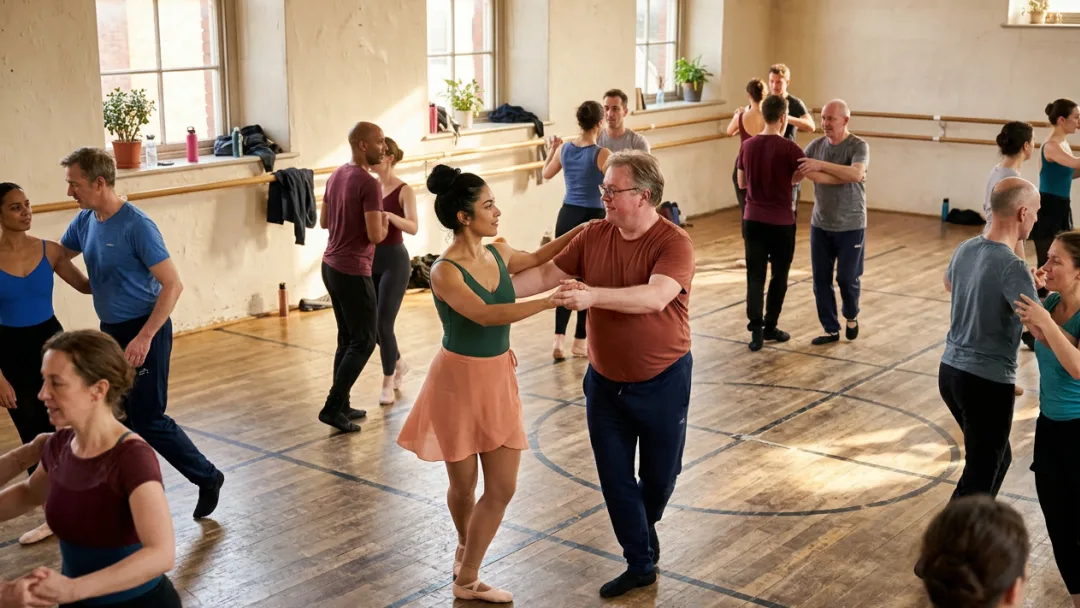
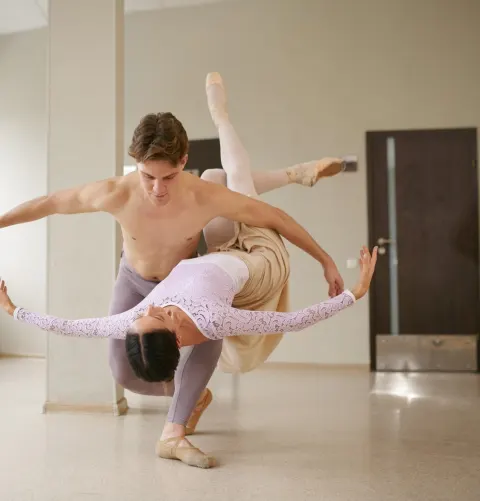
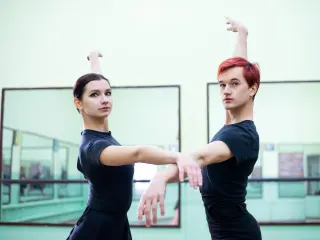
In ballet, the body is aligned not only through the feet. The shoulders, head and arms also shape whether a movement appears open, restrained or directed toward another person. From the front, you see different relationships than from the side: an extended leg line can stand out clearly from the side, while its length is less visible from the front.
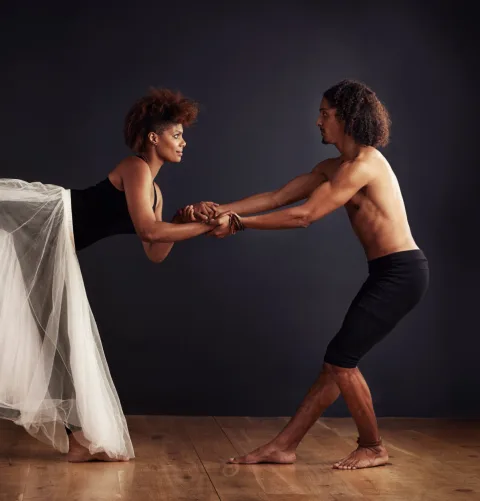
On a round stage, such differences are part of how you perceive the performance. If a dancer shows you her back, that does not mean you have missed the expression. Posture, tension and flow of movement remain legible. Turning toward a partner can also be more important than turning toward the audience. Constantly turning around would only blur these relationships.
The corps de ballet also does not have to face the same direction throughout to appear unified. Shared musical cues, similar movement qualities and coordinated spacing can bring a group together. Moving at the same time and facing the same direction are two different things. Swan Lake in particular invites you to see the ensemble as more than a backdrop for the soloists: repetition and shared rhythm give its group formations an effect of their own. The round stage makes it clear that this effect is also shaped by where you are watching from.
This way
Not like this
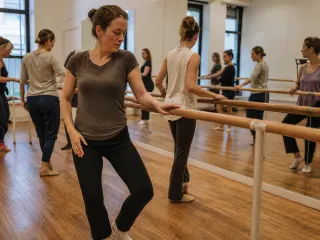
If you want to explore lines of the body and directions in space firsthand, you'll find suitable ballet classes in London on udansa.
A formation has not only a shape, but also an impact from every angle you view it from.
An in-the-round production also changes how you distribute your attention. On a front-facing stage, performers can be arranged one behind another, so that one person stands clearly in front of a group. With the audience all around, the same spatial hierarchy is not equally easy to read from every angle. A central position, a cleared space or several dancers looking in the same direction can then focus attention.
This does not mean that every such solution appeared in the Royal Albert Hall production of Swan Lake. It explains the choreographic challenge: an important event must remain clear in a space where no one can see all the dancers facing them at once. Entrances, encounters and a group moving apart therefore also contribute to the story.
This gives you a different way of watching. Alongside individual performers, you can also follow how space is opened up or closed off, and how a group frames a solo movement. If you want to get started yourself in London, ballet for adults offers a way to explore body alignment and movement pathways. As a viewer, this perspective adds to your understanding of dance theatre in London: it is not only the work itself, but also how it is staged in space that shapes the experience.
You follow a movement through space
When you observe a single person, shifts in weight, arm movements, and the continuation of a movement come into focus. A side or rear view can also show you how carefully a movement arc is connected.
You see relationships between the bodies
When you look at the group as a whole, you notice openings, clusters and recurring spaces between people. A single movement takes on meaning through its relationship to the other bodies and the open space between them.
You don't need any prior knowledge of Swan Lake to recognize the spatial design. You can observe pathways, distances, and changing orientations even without knowing the story. If you know the work, you can also distinguish what belongs to the story from what the spatial adaptation changes.
An in-the-round version is not automatically a different ballet, but a production designed for a different spatial setting. The story and music can remain the same while pathways and group formations are adapted. The extent of these changes depends on the production.
No, having the audience all around does not mean that all the dancers have to keep turning. Different views can also be created through pathways, staggered groups, and changing orientations. Still positions are possible, because the choreography does not have to show every dancer facing the audience at the same time.
Yes, in a ballet class you learn spatial awareness as well as body technique. Exercises away from the barre combine steps with changes of direction, pathways, and distances. This is not yet an in-the-round production, but it helps you understand why the same step looks different from another orientation.