Dance nights with clear descriptions
On udansa, you can find dance events in Paris with descriptions of each evening. Specific details help you get a sense of what to expect.

By Bernhard De LucaUpdated
On udansa, you can find dance events in Paris with descriptions of each evening. Specific details help you get a sense of what to expect.
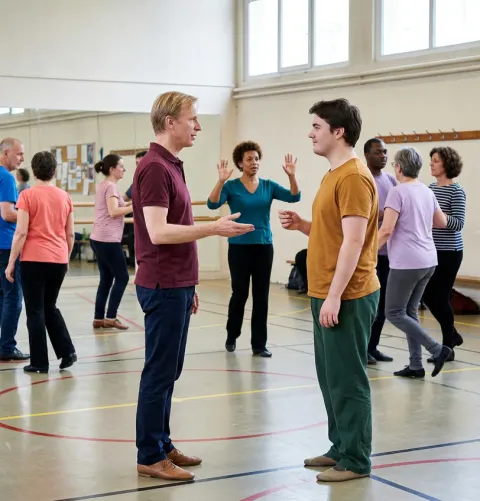
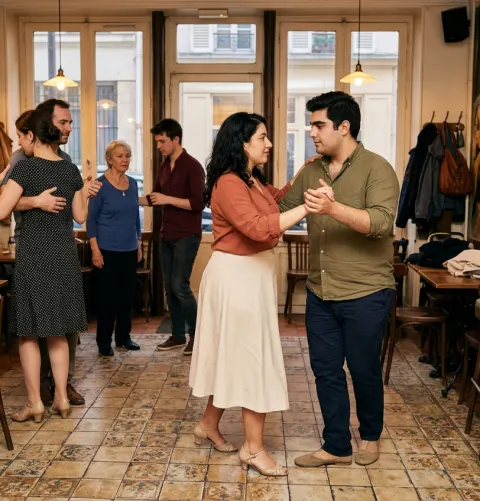
Maybe you simply want to dance with your girlfriend without having to explain your pairing. Whether an evening makes room for that is shown less by the promotional image than by how participation and interaction are described.
Freedom to choose your role in partner dancing means you can lead or follow regardless of your gender. This does not automatically mean that switching roles during a dance has been agreed upon.
When you’re assessing a queer dance party in Paris, you may come across terms like queer, LGBTQ+ or queer-friendly. They initially refer to the target audience or the event’s identity. An explicitly queer focus makes it clear whose experiences are meant to be considered. But it does not automatically determine how dance partners are paired on the dance floor.
The description of the roles answers a different question: Can anyone lead or follow, regardless of gender? An example statement like People of all genders can choose either dance role makes this clear. In contrast, Everyone is welcome leaves it open whether fixed gender roles are still expected when dancing. A photo of two women at the event does not prove a general rule either.
The third statement concerns how people treat one another: What boundaries apply, and what happens when they are crossed? Target audience, freedom to choose roles and protection against discrimination are three separate pieces of information. None replaces the others. This distinction complements the basic process of choosing a suitable dance event in Paris, without inferring a particular event format from a label. A text can be clear on one point and remain vague on another.
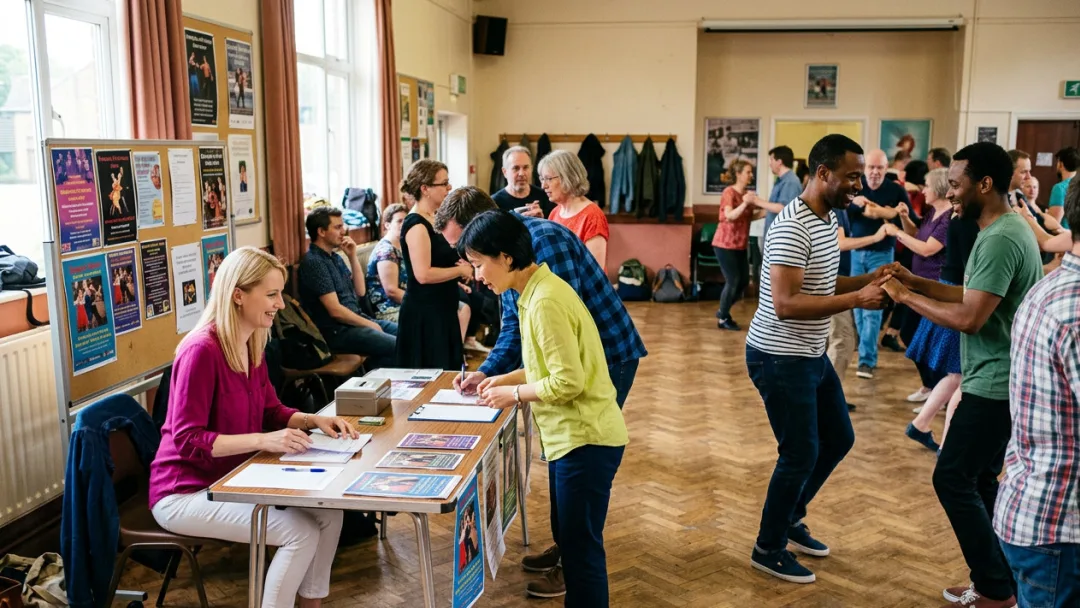
Leading and following describe roles in shared movement. The leader offers a direction, timing, or a figure; the follower takes in that information and shapes their movement accordingly. This implies neither a hierarchy nor anything about gender or sexual orientation. A woman who leads is therefore not dancing a man's role.
At an event with a short introduction, freedom to choose roles becomes especially concrete. If leaders and followers are addressed, people can choose a group based on the role they have chosen. But if men and women are divided without exception into two functional groups, that contradicts unrestricted role choice. How you clearly name leading and following can be kept separate from this division.
Free choice of roles also doesn't mean that your partner can take over the lead without asking in the middle of a figure. Such changes require mutual understanding. Nor does open dancing imply consent to close physical contact. An invitation to dance applies to that dance, not to every touch or further personal closeness. Clear rules respect a no to an invitation or figure, without requiring you to explain your identity, relationship, or reasons.
Informative
Not enough
A welcome only becomes tangible when the text also explains what boundaries apply and who will act if they are crossed.
An event description can explicitly reject discrimination and still be unclear. A clear code of conduct, for example, names racist, homophobic or transphobic remarks, harassment and unwanted touching. These examples explain what behavior is not accepted. They are more helpful than a general promise that everyone should be nice to one another.
Every rule needs someone responsible for enforcing it. An awareness team is a designated point of contact for support when boundaries are crossed, but its role is not the same everywhere. The offer becomes clear when details are provided about how to reach the team, how it supports affected people and what responses the event organizers may take. These may include a conversation, a pause in the event or asking someone to leave. Responsible wording does not promise absolute safety.
The same distinction applies to an LGBT dance night in Paris: missing information is not proof of rejection, but it is not proof of protection either. If the invitation and participation terms contradict each other, it is unclear how open the event is. If an important detail is missing, a direct question is enough, for example, who you can talk to about discrimination during the evening. This keeps your assessment focused on specific statements, rather than placing blanket trust in people you do not know or in an event name.
Visibility and shared points of reference
An explicitly queer evening can center the experiences of LGBTQ+ people. This makes it easier to identify the intended audience, but still says nothing about whether people of all genders are welcome to participate or which dance roles are planned.
Dancing without gendered role assignments
A role-open evening describes how you can lead or follow regardless of gender. It can appeal to a mixed audience without being explicitly queer-oriented. For some people, this is exactly the kind of shared dance practice that feels right.
Queer-friendly describes a stated openness toward queer people, but it is not a uniformly regulated event format. The term alone does not define the audience or the role distribution. Only specific participation requirements and codes of conduct make it clear what this welcome means for your dance night.
That depends on the explicitly stated participation requirements. Some queer events also welcome supportive people outside the LGBTQ+ community, while others limit their target audience. The label queer does not allow you to draw a reliable conclusion about access; what matters is the invitation as it is worded.
No, open role choice does not require you to master both roles. You can stick with the role you feel comfortable in. An event with open roles may still require prior experience; openness here describes how roles are assigned, not the dance level.
No, even an awareness team cannot guarantee a discrimination-free night. It can offer support and respond to incidents. Useful details include how to identify the team, how to reach them and what actions they can take, not merely the fact that they are mentioned.