Ballet mentality4 minutes

Patience when learning ballet: Mentally strong at the barre

In a nutshell
  • Patience when learning ballet comes from consciously focusing on minimal, weekly progress instead of unattainable perfection.
  • To overcome frustration in ballet, it helps to replace your inner critic with an objective observation of your own movements.
  • Mental training for ballet as an adult uses visualization to anchor complex movement sequences in the brain before the body executes them.
  • A healthy ballet mindset for progress as a hobby dancer views every correction from the instructor as valuable help, not as a personal failure.

Ballet challenges not only your body, but above all your mind. If you start training as an adult, you often stumble over your own, far too high expectations of the perfect movement.

What you need for your mental focus

  • The willingness to let go of perfectionism
  • A notebook for your personal training successes
  • Kindness towards your own physical limits
  • A fundamental understanding that ballet is a lifelong learning process

Why your mindset determines your progress in ballet

Classical ballet is fascinating, but as adult beginners, it presents us with an enormous mental challenge. While children learn through play, we tend to intellectually deconstruct every movement and immediately compare ourselves to the professionals on stage as we get older. Anyone who approaches the barre with unrealistic expectations will quickly reap frustration instead of joy. Adopting the right ballet mentality for progress as a hobby dancer means shifting the focus from the perfect end result to the subtle, everyday learning process. It is not about floating flawlessly through the room like in the world-famous repertoire of Swan Lake or Giselle, but about refining your own body awareness step by step.

Mental training for ballet as an adult helps you to actively stop impatient thoughts and silence your inner critic. If a pirouette fails or your balance wobbles, it is not a failure, but valuable information from your nervous system. Every correction from the instructor is a gift that shows you the way. If you learn to celebrate the small victories, such as standing calmly on one leg or a fluid arm movement, you will overcome frustration in ballet and find a deep, lasting satisfaction in your dance practice.

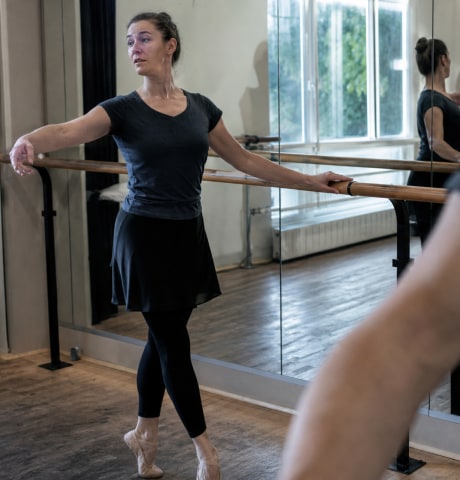
Looking in the mirror serves for orientation and precise alignment, not for self-criticism.

5 steps to more confidence at the barre

  1. Pressing the mental reset button

    Take a minute before entering the studio to take a deep breath. Leave the pressure of everyday life outside and focus your attention entirely on the here and now.

  2. Set a micro-goal for the class

    Choose a single, small goal for every class, such as a conscious foot stretch or an upright head posture. This shifts your focus away from the pursuit of general perfection.

  3. Using the mirror as a tool

    Use the mirror in the studio exclusively as a tool to check your alignment, not as a judge of your appearance or your skills. Look at yourself with benevolent objectivity.

  4. Actively absorb corrections

    When the instructor gives a correction, do not relate it to your value as a person. Take a deep breath, accept the feedback gratefully, and try to implement it physically right away.

  5. Focus on success

    End every training session by mentally thanking your body for its work. After the class, note down one thing that went better today than last time.

How to properly deal with mistakes and expectations

Yes, like this

  • Praise your own body for what it achieves today
  • See corrections as guidance for your own path
  • Look for the aesthetics in the simple basics

Don't do this

  • Constantly comparing yourself to professionals or others in the class
  • Viewing every wobble as a personal failure
  • Only being satisfied with extreme stretches and high legs

Your mental routine for ballet class

Before the class

Preparation

In class

During

After the course

Follow-up

Frequently Asked Questions

  1. Frustration usually arises from comparing yourself to professionals or younger dancers. Accept your anatomical conditions and compare yourself only to your own yesterday, to maintain the joy of learning.

Ballet classes for adults near you

Find the right studio and start your ballet journey with the right mindset.

View all matching classes

It is easier to dance together

On udansa you will find like-minded people who share your passion for ballet. Exchange ideas, find the perfect course nearby, and follow your path at the barre together with others.

It is easier to dance together