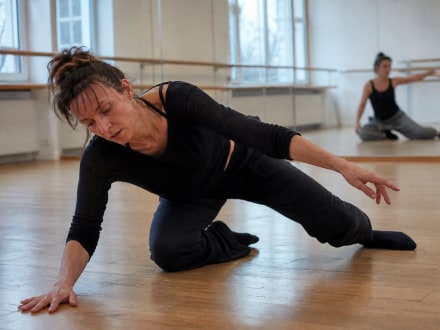
Experience the dynamics of modern techniques
Find like-minded dance enthusiasts and the right studios in your area on udansa to experience the diversity of contemporary forms of movement for yourself.


Modern dance revolutionized the world of movement by making gravity a partner. Discover how the great pioneers unlocked entirely new ways of bodywork through biomechanical principles.
Tension and relaxation in dance describes the biomechanical interplay between muscle activation and deliberate release. This principle enables dynamic changes in tempo, protects the joints, and gives movements their organic quality.
Anyone exploring contemporary forms of movement will quickly encounter a fascinating universe of different approaches. Historical and contemporary Modern-Dance-Techniken are not a rigid set of rules, but rather tools to express the human body in all its biomechanical diversity. Unlike classical ballet, which often strives to defy gravity, modern styles consciously work with the physical realities of the earth. They utilize body weight, the leverage of the joints, and the constant alternation between muscle tension and relaxation.
For those who want to dive deeper, the Modern Dance and Contemporary for adults guide offers an excellent initial orientation. Each of the major schools has developed its own biomechanical focus that continues to shape dance to this day. Whether it is the high-energy work from the core or the fluid play with the pendulum: understanding these historical currents fundamentally changes how we perceive and execute movement in space.
The pioneers of modern dance developed systems based on natural body functions. If you want to learn the Graham technique, you will encounter the principle of contract and release, the rhythmic contraction and release of the abdominal muscles, which is closely linked to breathing. The Limón technique in contemporary, on the other hand, focuses on the flow of breath and the play of dropping and catching body weight. Here, gravity is not fought, but understood as a partner that provides momentum and dynamics.
The Cunningham technique in dance follows a completely different, almost mathematical approach. It emphasizes the independence of the limbs and the stability of the spine, while the legs move with precise, ballet-like clarity. Finally, the more modern release technique of contemporary is about reducing unnecessary muscle tension, making joints permeable, and maximizing movement efficiency. All these approaches train body control in a unique way, without forcing the body into unnatural shapes.
When practicing at home, use your breath as a metronome: consciously exhale during strenuous movements to naturally support the necessary muscle tension in your core.
The body does not lie. Every movement reveals your inner attitude and the physical truth of the moment, when we stop fighting against gravity.
Biomechanics in contemporary dance is based on physical laws. Gravity in contemporary dance is arguably the most important constant: every upward movement requires a conscious push into the floor, while every release creates kinetic energy for the next step. The harmonious interplay of tension and relaxation when dancing ensures that movements appear organic and injuries are avoided.
By specifically engaging deep muscle groups, dancers learn to relieve their joints and let movement flow. This biomechanical awareness helps not only in the contemporary studio, but can also be applied to many other dance styles. Anyone who learns to use their own pelvis as a power center and let their breath flow gains presence, stability, and dance freedom in every dance style.
Graham and Cunningham techniques
Focuses on the powerful activation of the core through contraction and a clear interplay with the breath. This method requires strong deep muscles and emphasizes emotional expression directly from the center of the body.
Limón and release techniques
Focuses on the conscious release of muscle tension and the use of momentum and pendulum movements. Through the permeability of the joints, movement becomes fluid, highly efficient, and preserves the body's energy.
The Graham technique is based on the principle of contract and release, which is the contraction and release of the torso. It is very expressive, emotional, and requires strong activation of the deep abdominal muscles.
Find the right course near you and get to know the different techniques in practice.
 Learn Graham Technique: Contraction and Release in Modern DanceThe Graham technique forms the foundation of modern expressive dance. Learn how to master contraction and release while standing and add new depth to your dance.
 Limon technique in modern dance: learning fall and recoveryDiscover how to use the Limon technique in modern dance to transform gravity and breath into fluid, standing sequences. A practical guide for adults.