Kids dance5 minutes

Kids dance in Berlin: Choose courses for the little ones

By Bernhard De LucaUpdated

In a nutshell
  • Children's dance for the youngest focuses on playful body awareness and imagination instead of rigid choreography.
  • For preschoolers, creative children's dance is best, as it trains motor skills and a sense of rhythm without drills.
  • Good dance schools offer non-binding trial lessons and rely on trained dance educators with child-friendly methods.
  • Parents should look for joint-friendly sprung floors, clear rituals, and child-appropriate group sizes.

Small children want to jump, run, and grasp the rhythm with all their senses. A successful children's dance course offers exactly this space, completely without performance pressure and fixed partner dance rules.

DefinitionCreative Children's Dance

Creative Children's Dance is a dance-pedagogical movement concept for children from about three years of age, which promotes motor skills, spatial awareness, and rhythm through playful fantasy journeys and free forms of expression. It consciously avoids fixed dance steps and serves as a basic motor training.

How age-appropriate children's dance in Berlin succeeds

When families in Berlin look for the right introduction to the world of dance, it is rarely about rigid step sequences or drills. Instead, the focus is on the joy of moving to music, the discovery of one's own body, and the shared experience in a group of peers. Whether a course for children's dance in Berlin is enriching or overwhelming for a child depends significantly on how age-appropriate the lesson is structured. For the youngest in preschool age, imaginative stories, playful rituals, and a protected space count for far more than formal dance styles.

Well-thought-out instruction differs fundamentally from courses for teenagers or adults. Instead of a fixed beat or complex choreographies, children's dance in Berlin teaches basic skills such as balance, spatial awareness, and rhythmic coordination. Children learn how loud and quiet, fast and slow are translated into movement. If you would like to know how contemporary instruction has developed over generations, take a look at the contemporary dance scene in Berlin, from whose methods many modern movement concepts for children draw today.

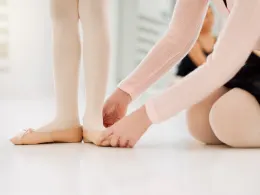
Top-down view of the legs of a little dancer and a young ballerina in pointe shoes on a white wooden floor with empty space
Wearing non-slip socks and using imaginative tasks, children discover the space and their own rhythm.

Formats from creative dance to first rhythms

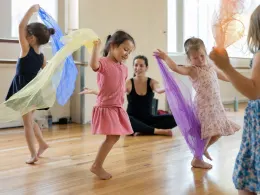
When searching for a suitable children's dance school in Berlin, parents often encounter very different concepts. For three to five-year-olds, creative children's dance forms the methodological heart. Here, children transform into fluttering butterflies, prowling big cats, or sturdy trees in a storm. Through such metaphors, the little ones explore movement qualities quite intuitively, without feeling like they have to work through a formal movement pattern. It is about allowing one's own movement impulses while simultaneously experiencing the transition between tension and relaxation.

It is only with primary school age that interests begin to differentiate. Some children are drawn to the classic lines and the discipline that the Staatsballett Berlin demonstrates on the big stages, and they begin with preparatory children's ballet. Others are drawn to powerful rhythms, such as those that can be admired at the children's carnival during the traditional street festival Karneval der Kulturen in Berlin, and they find their way more into street dance or Hip-Hop groups. It remains important in every phase that the lessons function without performance pressure and that the child's urge to move is not forced into a tight corset.

Choosing a children's dance course: recommendations for parents

How to succeed

  • Ensure there are sprung floors and enough room to move
  • Take advantage of a non-binding trial lesson to get to know each other
  • Pack comfortable dancewear and non-slip socks
  • Give the child time to build confidence at their own pace

Common mistakes

  • Expecting fixed step sequences and perfection from toddlers
  • Signing contracts without a trial class first
  • Wearing stiff street shoes or restrictive clothing
  • Pressuring the child to participate when they would rather watch first

Children do not want drills, they want images that spark their own imagination and channel their natural urge to move into structured paths.

Dance educator for children's dance

What parents should look for when choosing a studio

A trial class is the most reliable way for parents to make a decision. During your first visit, pay less attention to the room decor and focus primarily on how the instructor welcomes the group. Established greeting and farewell rituals provide young children with emotional security. A qualified dance teacher does not correct young children with sharp reprimands, but rather redirects their attention in a playful way. The floor is also important: a sprung parquet or sports floor protects the sensitive joints of growing children much better than bare stone or laminate surfaces.

Clarify organizational questions in advance as well: Are parents allowed to sit on the sidelines during the first trial classes to provide support, or is the child expected to enter the room alone immediately? Reputable studios allow for a gentle transition, but aim for children to arrive in the group without parental distraction after a short settling-in period. Also, check contract terms and cancellation periods, as children's interests can change quickly. Flexible monthly contracts or transparent course blocks offer significantly more relief here than multi-year commitments.

Two approaches for little dancers

Creativity

Creative Children's Dance

Free exploration for preschoolers

In creative children's dance, the focus is on imaginative imagery and finding movement freely. Children train their rhythm and motor skills playfully through stories, completely without performance pressure or fixed posture requirements.

Structure

Preparatory dance styles

First forms for school children

Structured dance forms introduce concrete techniques step by step. Children learn their first basic steps, how to count beats, and how to maintain common lines in the room with more spatial discipline.

Frequently Asked Questions

  1. From about three years old, children can participate in their first creative dance classes. Younger children from zero to three years old usually dance in parent-child formats, as they still need a steady caregiver for orientation in the room.

Discover children's dance classes in Berlin

Find age-appropriate offers for creative children's dance and movement classes for your child.

View all suitable classes

Finding kids dance classes in Berlin made easy

Compare offers for the little ones in your area and find the dance class that fits your family's daily routine.

Finding kids dance classes in Berlin made easy