Your learning goal needs a partner
On udansa, you can find people to dance with in Rome and try out a correction from class when you practice together.

By Mary De LucaUpdated
On udansa, you can find people to dance with in Rome and try out a correction from class when you practice together.
Sometimes an entire sequence flows smoothly until the same transition gets stuck again. If you want to work on it specifically in Rome, what matters most is whether someone can identify the cause and make it clearly visible from the outside.
Weight transfer means shifting your body weight from one supporting foot to the other. Only once the new foot is supporting you can the previous standing foot move freely.
For private dance lessons in Rome, an observable learning goal is more helpful than a general wish to become a better dancer. Three types of goals work well in private lessons: a technical difficulty, a connection to the music, and a specific sequence of movements.
With a technical difficulty, the teacher can distinguish whether, for example, a turn is breaking down because of the weight shift, an overly large step, or moving the arms too soon. A visible difficulty is not automatically the cause. If your upper body is wobbling, being told to keep it still won’t help much as long as your supporting leg isn’t bearing your weight yet.
Musical awareness might involve hearing the steady beat and using a familiar movement to match it. The movement is simplified at first, so listening and dancing don’t demand all your attention at the same time.
With a short sequence of movements, you can examine transitions, directions, and weight shifts one at a time. If you learn movements mainly by watching, it can also help to look at common observation mistakes when copying movements. Private dance lessons give you room to work on the specific part you’re getting stuck on, without having to cover an entire style in one session.
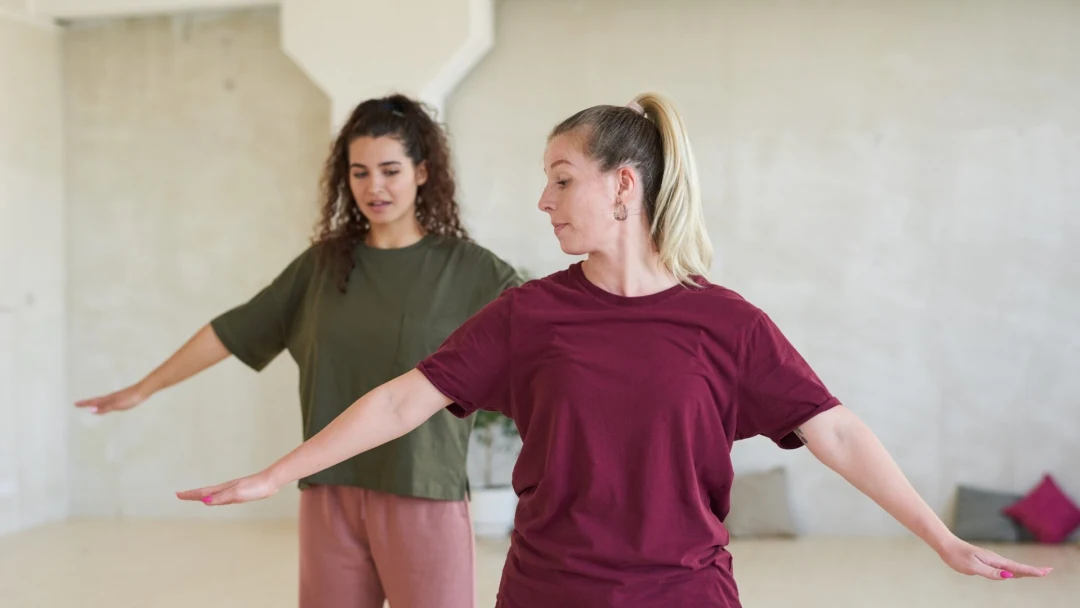
In private lessons, a teacher can respond to your movement more often. But that doesn't mean every minute should bring a new correction. After a tip, you need repetitions to feel the change in your movement. Too many tips at once turn one manageable task into several competing tasks.
A good learning process therefore alternates between observing, explaining, trying things out, and dancing again. For example, you might start by changing only your step length. If the transition stays stable, you can add the music. Only then can you tell whether the correction holds up under time pressure, too.
In partner dancing, a familiar teacher may also unconsciously compensate for things that still cause you difficulty with other people. So a smooth sequence with them doesn't prove that you can dance the same movement confidently with every partner. In a group, you'll encounter different movement habits, while dancing solo calls for a different kind of attention to shared timing.
Private lessons and group classes can each cover different parts of the same learning goal. A correction from a private lesson becomes more reliable when you dance with others. To explore other formats, take a look at dance classes in Rome.
Do this
Not this way
In the course filter, you’ll find current listings for Rome and can search for lessons that match your specific learning goal.
A useful learning goal describes a movement you want to change, not just a desire to get better overall.
A lesson agreement describes what you will work on and the conditions under which the lesson will take place. The learning goal can be provisional: for example, you might want to stabilize a transition while the instructor first observes which movement is making it difficult. A binding promise of success after a fixed number of lessons does not fit this open-ended learning process.
Before booking, clarify the learning goal, lesson length, participants, room, language of instruction, and cancellation and rescheduling terms all at once. Whether you work alone or with a partner changes how the time is used: when there are two learners, both can receive feedback, but the instructor's attention is shared. The room should have enough clear space, a suitable floor, and the agreed use.
Physical corrections require your consent. Demonstrations, verbal cues, and touch are different teaching methods, and none is automatically required. Recording a video also requires the consent of everyone who can be identified in it. You can find tips for making a useful recording in short practice videos in dance classes.
A cancellation policy sets out how reserved lesson time is handled. It should clearly distinguish between your cancellation, rescheduling, and a cancellation by the instructor.
Attention to your own process
You can repeat a part without having to keep up with a group's learning pace. The teacher sees how you perform it individually and can adapt the explanation or exercise accordingly.
Finding your bearings in changing situations
You experience how your movement fits with the shared tempo and with other people. The group offers opportunities to compare and creates situations that cannot be created with a familiar teacher alone.
Yes, private lessons can be useful even without prior experience. A manageable goal would be to perform a basic step with a confident weight change to the music. A group is also suitable for getting started more broadly, because you experience shared routines and learning with others.
It is not possible to reliably determine the number needed without knowing your learning goal and how you move. A single tip can make a difficulty easier to understand, but the new movement needs to become established through practice. You can see progress when you can make the change without constant reminders.
Yes, individually booked lessons can also be arranged for two learners. The focus can be on your movement together or on how each of you performs the steps. The lesson time is then not dedicated to just one person, which affects how the focus is set if you have different goals.
Wear clothes that do not restrict your movement, and shoes suited to the dance style and floor. For getting started, comfortable workout clothes and well-fitting shoes are a good choice. Long, loose accessories can get in the way when turning, while new or unfamiliar shoes can distract unnecessarily from the correction itself.