Watch ballet together
On udansa connect, you can find people in Paris to share a ballet outing with and talk about what you've seen.

By Mary De LucaUpdated
On udansa connect, you can find people in Paris to share a ballet outing with and talk about what you've seen.
When many bodies start moving at once on stage, the most spectacular move often catches the eye. Yet sometimes the connection lies in a small gesture or in who stays still.
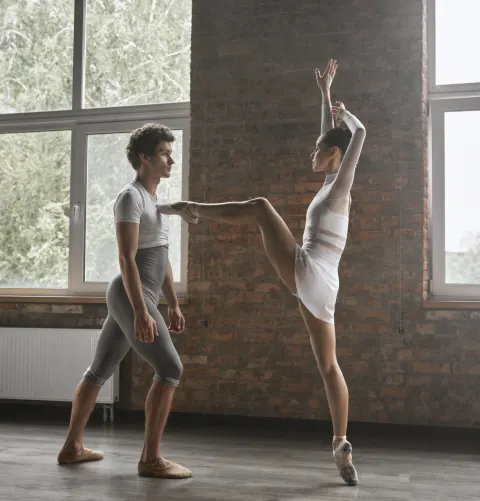
An arabesque is a ballet position in which you stand on one leg and extend the other behind you. The position of your arms, your upper body, and the height of your extended leg shape the visible line.
When you watch a ballet performance in Paris, you can first recognize its classical vocabulary in the organization of the body: The legs are turned out from the hip joints, the upper body remains lifted, and the arms trace shaped pathways. This outward rotation is called En dehors. It does not simply mean turning the feet outward.
A Plié, the bending of the knees, prepares for a jump and cushions its landing. In an Arabesque, the leg extended backward lengthens the line of the body. What matters is not only the position achieved: Gliding into it, holding it, and moving out of it are all part of the expression. The transitions turn individual positions into a continuous movement.
Paris offers a fitting historical connection: From 1821, the Paris Opera Ballet performed at the Salle Le Peletier, where Romantic ballet took shape. This context helps you understand floating lines and otherworldly stage figures as artistic choices. They are not proof that ballet always has to look like a fairy tale. You can find the broader cultural context under Dance traditions and dance culture in Paris.
A solo focuses attention on a single figure. A quick sequence of steps can show determination, while a hesitant movement can suggest uncertainty. A soloistic variation is a fully developed dance passage that highlights one person. It can characterize a role or, above all, make musical and technical expression visible.
In the classical stage duet, the Pas de deux, the relationship between two people becomes clear. A supported balance shows more than skill: closeness, eye contact and the release of a hand can express trust or distance. In the grand classical duet, a shared opening is often followed by a slow partnering passage, individual variations and a shared coda, meaning a lively finale. Not every duet follows this form.
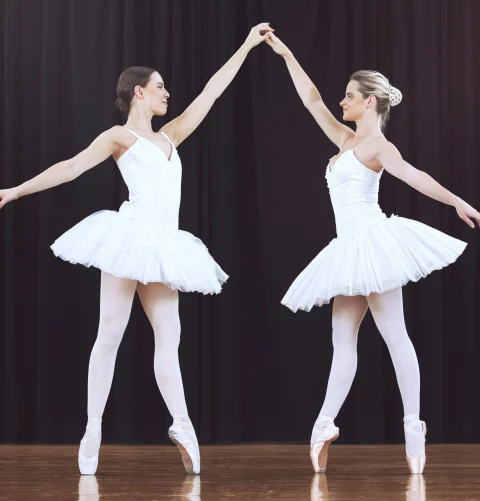
The ballet ensemble, also called the Corps de ballet, shapes the shared space. Lines, diagonals and mirrored groups can establish an order that a soloist then breaks through. The group is an agent in its own right. When everyone steps back and one person remains, a statement emerges without a spoken word. What matters to your perspective is this stage function, not the institutional rank of the performers.
This way
Not like this
If you’d also like to experience the language of movement physically, you can find ballet classes in Paris on udansa.
If you only see the highest jump, you might miss the moment when the figure makes its decision.
A long skirt can softly trace a movement, while a short tutu reveals the line of the legs. Light can bring a group together or separate individual bodies. These elements guide your perception, but they do not define the dance style on their own. Classical technique can also appear in simple costumes and without painted scenery.
Just as important is the relationship to the music. During a slow passage, a held position can extend beyond a musical accent. In fast sequences, small steps can intensify the pulse. When a movement returns later, but is now danced by the entire group, its effect changes. You don't need an invented plot reason for that.
Parisian venues are also part of the context: the Palais Garnier opened in 1875 and became the home of the Paris Opera Ballet. The Opéra Bastille, opened in 1989, became the second venue of the Paris Opera. These historical reference points don't tell you which aesthetic a particular production uses. The name of the venue is no substitute for looking at the choreography. For a broader picture of everyday life there, see the overview of dance and dance culture in Paris.
Movement unfolds in a dramatic situation
An outstretched hand can be a plea, a retreat a refusal. You follow how the relationship between characters changes. Recurring gestures connect individual scenes into a plot.
Movement organizes music and space
An outstretched hand can be part of a line without making a request. You follow how directions, tempos, and groups respond to one another. Recurring movements connect the piece even without a story.
You don't need to know the plot, but a brief synopsis can help with a narrative ballet. It makes encounters and conflicts easier to understand. Then, on stage, you can observe how movements shape the situation instead of trying to translate every gesture into a specific sentence.
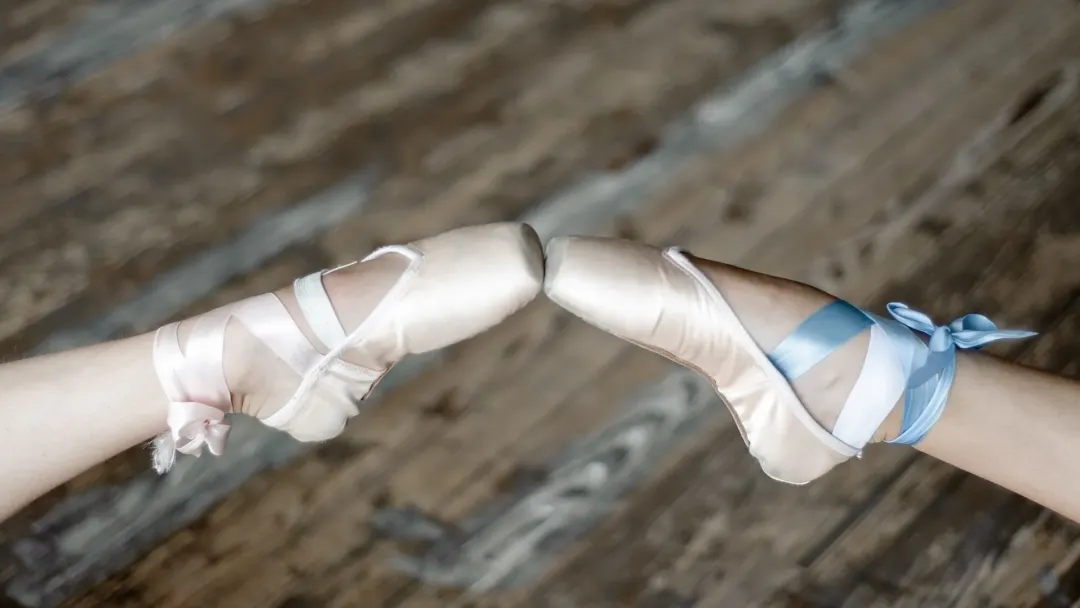
En pointe dancing is a specific technique and isn't intended for every role or choreography. It changes the body's line and the impression of contact with the floor. Dancers in soft ballet shoes can also perform classical steps, jumps and turns; the choice of shoes alone doesn't determine the style.
Ballet isn't danced exclusively to orchestral music. Smaller ensembles, piano music or recorded music can also accompany a choreography. What matters for your understanding is the relationship to the music: a movement can hit an accent, continue a melody or be deliberately set against the musical pulse.
You can understand classical ballet without having any dance experience. Paths through the space, repetitions and relationships between characters are directly observable. You don't need to name every step. Even the difference between a slow balance and a rapid sequence of jumps can help you notice how a scene is shaped.
 How Dance Styles Shaped Paris
 Salsa in Paris: Kubanisch, auf Linie oder als Rueda?
 Paris Opera Ballet: From Court to Company
 Bal musette in Paris: Waltz or Java?
 How Cancan Became a Revue at the Moulin Rouge in Paris
 Contemporary Dance in Paris: Reading a Choreography
 Die Rue de Lappe in Paris und die Wurzeln der Musette