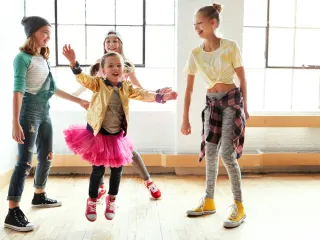
Room for little dance beginnings
On udansa, you can find dance classes for your child in London. Dedicated groups and holiday programs help you find the right setting to get started.

By Bernhard De LucaUpdated
On udansa, you can find dance classes for your child in London. Dedicated groups and holiday programs help you find the right setting to get started.
One child immediately remembers a sequence of movements, while another prefers to invent their own steps. They may be the same age and still need different instruction so curiosity doesn’t turn into overwhelm.
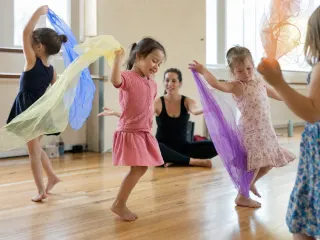
Creative dance for children is dance instruction in which children develop their own ways of expressing themselves, a sense of rhythm, and spatial awareness through guided movement activities. Stories, images, and materials can serve as starting points.
When you choose dance classes for your child in London, the age range is first and foremost a guide for organizing the group. It does not reliably indicate how long your child will listen, whether they want to copy movements, or how comfortable they feel without a familiar companion. Development does not progress at the same pace in every area: a child can have a good sense of rhythm and still need support when moving between groups.
That is why specific activities are more useful than year of birth when getting started. Starting and stopping to the music helps your child practice noticing a signal and slowing their body down. Moving across the room means keeping a safe distance and following a direction. A short sequence of movements also requires memory. These activities can be made more or less challenging.
The right class offers an achievable starting point and room to develop. A child who first moves only their arms can add steps later. Watching does not automatically mean a lack of interest; it can be a way of getting oriented. Observing and copying dance movements also involves several different skills. The wider selection of dance classes in London by learning goal helps you understand the different class options; for children, readiness to develop remains key.

Playful instruction is easily mistaken for a class without a learning goal. Yet a story can make precise movement work possible. “Sneak quietly through the room” directs attention to weight and controlled foot placement. “Grow tall and then get small again” lets children explore different body heights. Switching between fast and slow music makes tempo something they can feel in their bodies, even without technical terms.
Technique begins when a movement becomes more intentional, secure or clear. That does not mean long sequences of drills are needed right away. A teacher can demonstrate a landing, guide a short repetition and then incorporate the same movement into a game. Clear corrections identify an action that can be changed: “Land more quietly” gives direction, while “You’re clumsy” only judges.
The amount of technique is right when the children understand the purpose of the task and focused periods are balanced with variety. More repetition can help when a child enjoys seeking precision. More open-ended tasks can work when they learn through imagery and experimentation. Range of movement and body shape are not reliable measures of talent. Forced stretching, painful positions and shaming comparisons have no place in corrections suited to children. Visible differences within a group are normal and do not need to be immediately evened out.
Do
Not like this
In the course filter on udansa, you'll find specific children's groups, holiday programs and information on available spots in London.
An age label describes a group, but not yet the activities your child can grow through in it.
A performance can give children a shared goal: they remember a sequence, find their place, and experience how several contributions fit together. To do this, a sequence is repeated frequently. That is understandable, but it changes the focus of the lesson. Time for new movements and their own ideas can give way to a reliable presentation.
That is why the role performances play in lessons is important. A small showcase at the end of a class has different requirements from a set stage choreography. Costumes, cues, and waiting backstage are additional tasks, not proof of dance maturity. A child can enjoy dancing in class and still feel uncomfortable in front of an audience.
A good introduction does not need a finished product to show off. Progress also shows when your child recognizes a rhythm, keeps moving after a mistake, or contributes their own ideas. If a performance is planned, check once whether participation is voluntary and whether lessons remain possible without taking the stage. This information helps you set appropriate expectations from the start.
In a holiday program, shared final sequences can create a time-limited structure. An ongoing group can deepen what they already know over a longer period. Both can work, as long as the demands, repetitions, and performance goals suit your child's readiness.
Open-ended tasks with a clear framework
Your child explores different ways to express an idea physically: How does something heavy move, and how does something light move? The task has several suitable solutions. This allows children with different movement vocabularies to work together.
Connect familiar movements mindfully
Your child practices a manageable sequence and notices what becomes more confident with each repetition. A dependable routine can be especially comforting when open-ended tasks initially feel unsettling. Small variations leave room for personal expression.
The right time to start depends on the class format and your child’s development, not on a fixed age limit for all children. Parent-child classes can include a parent or caregiver; independent groups require more confidence without you. Age recommendations define the intended group, but they do not replace considering the activities involved.
Yes, a shy child can take part if they are introduced to the group without pressure to perform. A familiar routine, moving together and time to watch make it easier to join in. Quiet participation counts too; performing solo in front of the group does not have to be the first step.
For a fun introduction, choose comfortable sportswear without loose jewellery; footwear depends on the class. Trainers work for many movement-based classes, while ballet slippers suit ballet exercises. Clothes should not feel tight when crouching or keep slipping when turning, and long hair should be kept out of the face.
A holiday class can be a good way to get started if the activities are accessible to beginners and leave enough time to rest. Short, intensive formats bring new experiences together and can progress more quickly towards learning a sequence as a group. An ongoing group, on the other hand, offers recurring routines and more time to practise individual movements.