Plan your first dance together
On udansa, you’ll find wedding dance classes in London to help you prepare your dance together. Bring your version of the song and a specific goal for the lesson.

By Mary De LucaUpdated
On udansa, you’ll find wedding dance classes in London to help you prepare your dance together. Bring your version of the song and a specific goal for the lesson.
Between the seating plan and outfits, the first dance can easily get left as an open task. A manageable plan takes the pressure off preparations and helps you keep things moving at the celebration, even if a step doesn’t go as planned.
If you’re planning wedding dance lessons in London, your song is the most important starting point. Its tempo, accents, and phrases determine how much time there is for steps and transitions. A romantic lyric doesn’t make a song a waltz: the music needs a suitable triple meter for that. With many pop songs, you can instead create a calm, repeatable sequence for two without learning a specific ballroom dance in full.
A secure weight transfer is more important than a long list of figures. This means your body arrives over the supporting foot before the other foot takes the next step. If your weight stays between both feet, changes of direction and turns become unstable. That’s why a simple basic movement that fits the music and makes sense to both of you is helpful in lessons.
Your roles are also part of the preparation: one person initiates movement, and the other responds without being pulled. You’ll find tips on coordinating your dance roles. Experience alone doesn’t determine who should lead. For practicing later, a short, easy-to-follow practice video is also more helpful than a recording full of new figures: a successful transition shows you what you can practice again at home.
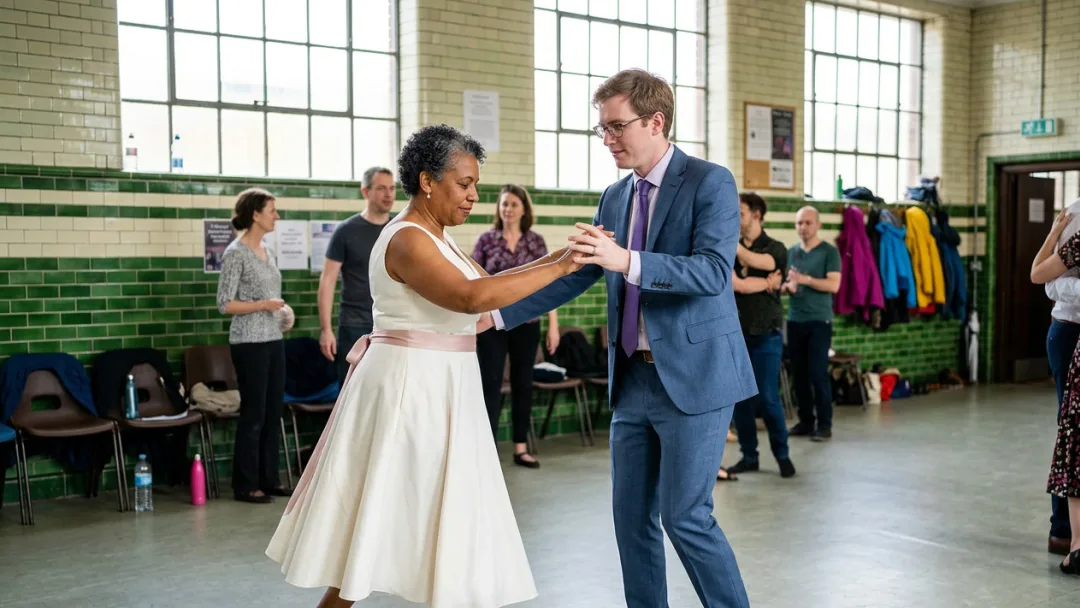
Listen to your recording together from beginning to end. Decide with your dance partner whether you want to dance to the whole song or a shortened section, and note audible reference points such as the start of the vocals and the chorus. This gives you the musical foundation for your lessons.
Note down which steps you both already know, whether you can keep the beat, and which moves feel uncomfortable. Agree on a shared goal, such as a relaxed sequence with a turn. The less experienced person should be able to follow along without constant verbal cues.
Schedule a dress rehearsal before the celebration and, before that, several short practice sessions between lessons. Separate learning sessions from review rehearsals in your calendar. That way, after a correction, you’ll have a chance to apply it yourself instead of adding new moves just before the wedding.
Use your first class to learn the starting position, musical cue, and a repeatable basic movement. Before adding any figures, make sure you execute the weight change cleanly. You’ve got the basics down when you can start moving together from a standstill without counting or pulling on each other.
Only add movements that you can reach from your basic sequence. Practice the step before and after a turn too, instead of practicing turns in isolation. Set a stable ending position without a risky lift, one you can safely reach from the final movement section.
Work on one sticking point per rehearsal and start the music a little before it. Then dance through it once in full. Agree on your basic move as a fallback if a figure falls apart. The rehearsal is a success if, after a mistake, you get back in time together.
For your dress rehearsal, use the final audio track, your wedding shoes, and clothing with a similar hem width. Limit your practice area to the designated dance floor and dance all the way through, from walking on to walking off. Afterward, cut any extras you’re unsure about instead of adding new figures.
On udansa, find current classes and dates in London for the wedding dance you've chosen together.
Like this
Not like this
Preparation
Practice
Dress rehearsal
Start early enough to allow for several practice sessions on your own and a final rehearsal between lessons. There is no set number of weeks that works for every couple: your previous experience, the difficulty of the routine and the time you have to practice together all affect how much time you need. If you are short on time, simplify the choreography to a reliable basic move with a clear beginning and ending.
The number of lessons you need depends on how confidently you move to the music and how elaborate you want your routine to be. A useful measure is whether you can dance it all the way through without help. If you constantly need prompts or lose your place after every turn, you cannot yet remember the routine on your own, or it is too challenging.
No, a Waltz is not required for your wedding dance. What matters is that your movements fit the beat and tempo of your chosen song. A song in 4/4 time does not need Waltz steps. To start with, all you need for your lessons is a repeatable couple dance move that you can perform comfortably without working against the music's accents.
Build your routine around the less experienced person's level of confidence. The more experienced person can make the moves easier to anticipate, but should not pull more forcefully or keep teaching during the dance. Practice difficult sections slowly, with clear weight changes. This helps you develop a routine you can do together instead of two tasks with different levels of difficulty.
Your dance should last only as long as you can confidently perform your routine without unnecessary repetition. You do not have to use the whole song you chose. A shorter section with a musically satisfying ending may work better than adding several more verses. Choose the version you will use before building the choreography, so you can prepare the ending deliberately.
Yes, you can practice weight changes, hand connection and small transitions on a clear, non-slip surface. Move obstacles out of the way and take smaller steps without changing the sequence of movements. Traveling steps also need a larger open space. Do not force turns in shoes with soles that grip the floor firmly, as this can twist your feet and knees against each other.