Dance equipment4 minutes

Dance mirrors for your home: Finding the right mirror

By Mary De LucaUpdated

In short
  • For dance training at home, a reflective surface of at least 180 centimeters in height and 80 centimeters in width is necessary to fully capture movements from head to toe.
  • In rented apartments, mobile floor mirrors or shatterproof acrylic panels with safety film offer the safest alternative to crystal glass, which is difficult to mount.
  • Acrylic mirrors should be at least 3 millimeters thick and adhere to an absolutely flat backing plate so that the reflection does not distort during dynamic steps.
  • The ideal setup location requires at least two meters of free space in front of the mirror surface as well as glare-free light from the front or above.

Visual feedback turns your living room into an effective dance studio. With the right dance mirror for your home, you can precisely correct your posture and protect your living space from breakage at the same time.

What you need before buying

  • Free floor space of at least 2 x 2 meters in front of the mirror surface
  • Sufficient ceiling height for extended arm positions
  • Glare-free light source from the ceiling or mirror side
  • Measuring tape and spirit level for exact alignment
  • Smooth wall surface or sufficient space for a rolling stand

Types, safety, and distortion-free reflection in your living space

If you are refining choreographies and lines at home, you will quickly reach your limits without visual feedback. A dance mirror for your home makes posture errors, messy foot positions, and asymmetrical arm movements immediately visible. However, living spaces have different requirements than a professional studio: limited space, rental agreements that prohibit drilling, and safety concerns regarding pets or children running around require careful consideration before you buy.

For your own apartment, there are essentially three types to choose from: classic wall mirrors made of crystal glass, shatterproof mirror tiles made of acrylic, and rollable or foldable floor mirrors. Glass offers the most authentic optical flatness, but it comes with significant weight and the risk of shattering. If you cannot drill holes in a rental apartment, a self-adhesive acrylic mirror wall for dancing or a sturdy floor mirror for dance training is the more flexible solution. When choosing acrylic, look for a minimum thickness of 3 millimeters, as thinner sheets lead to wavy distortions that can disrupt your balance during turns.

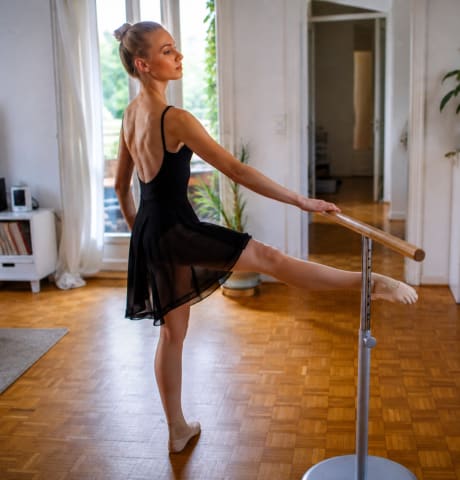
You will achieve optimal training results if you supplement your mirror surface with suitable accessories. A mobile dance floor for home protects your joints and parquet flooring, while a free-standing ballet barre for home offers additional stability for barre exercises. Choose a location where you can keep a distance of at least two meters from the reflective surface so you can keep your entire body in view, from your toes to your extended arms.

5 steps to the perfect home mirror

  1. Measuring the training area and distance

    Measure the wall area and the space in front of it. You need at least two meters of distance from the mirror to keep turns and jumps completely in your field of view.

  2. Determine the right mirror material

    Choose rollable floor mirrors for maximum flexibility or acrylic sheets for rental apartments where drilling is prohibited. Real glass is best suited for permanent wall installations.

  3. Align the distance to the floor precisely

    Make sure that the bottom edge of the mirror is at most 10 to 15 centimeters above the floor. This is the only way to check your footwork without errors.

  4. Secure the mirror safely

    Attach wall elements with special holders or align the rolling stand stably. Afterwards, carefully peel off the protective films.

  5. Testing flatness and field of view

    Stand in the center two meters away from the mirror and move sideways. The image must not show any waves or distortions at any point.

Selection and positioning in comparison

Correct

  • Choose safety glass with anti-shatter film or sturdy acrylic
  • Plan for at least 80 cm of width per dancing person
  • Mount mirror edges close to the floor for full foot control
  • Lock the casters on mobile frames securely during training

Avoid

  • Applying thin adhesive films to uneven woodchip wallpaper
  • Using narrow wardrobe mirrors under 40 cm in width
  • Hanging mirrors too high, so that the feet are cut off
  • Leaving mobile rolling mirrors without locking brakes to move freely

Checklist for your training mirror

Before you buy

Planning

During assembly

Setup

In daily training

Practice

Frequently Asked Questions

  1. For a full-body view including jumps and lifts, the mirror should be at least 180 centimeters high and at least 80 centimeters wide. Multi-part elements can be expanded if necessary.

Find dance courses near you

Use your mirror training for the next class and discover new dance styles.

View all matching courses

Don't just train in front of the mirror

On udansa you can find dance courses, workshops, and like-minded people in your city to try out your new moves on a real dance floor.

Don't just train in front of the mirror