

Find your dance community on udansa
Whether you are looking for like-minded people for your dance improvisation or need a steady partner for your next course: at udansa you will meet people who share your passion.

By Mary De LucaUpdated

Whether you are looking for like-minded people for your dance improvisation or need a steady partner for your next course: at udansa you will meet people who share your passion.
Moving to the music without fixed steps requires courage. With the right exercises, you will learn to let your body react intuitively to the music and break down mental blocks.
Immediate applicability
All presented methods can be implemented directly at home or in the studio without any prior knowledge.
Focus on musicality
The exercises specifically train the connection between your hearing and physical execution.
Professional foundation
The selection is based on proven concepts from dance pedagogy and social dance.
Independent selection
No association, dance school, or service provider has paid for a placement on this list.
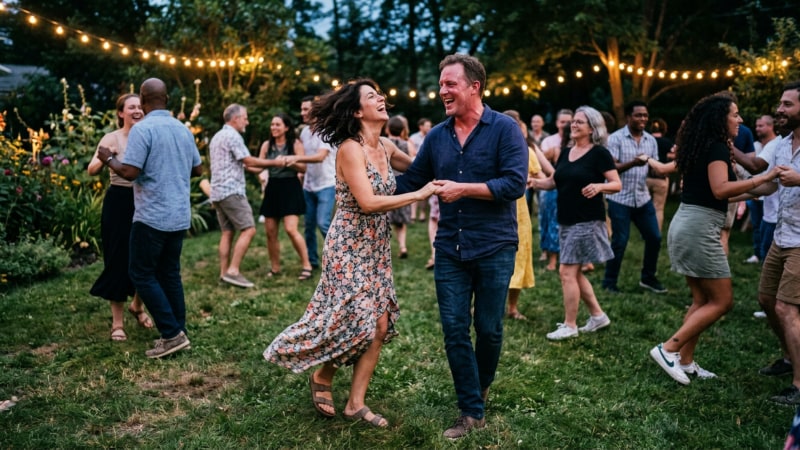
Solo exercise, 5 minutes, for all levels
Move only one single body part throughout an entire song, for example just your shoulders, hips, or hands. This exercise forces you to leave your usual movement patterns behind and find new ways to interpret the rhythm.
Solo exercise, 1 song length, perfect for at home
Close your eyes and focus exclusively on what you hear. Let your movements emerge directly from the acoustic stimuli, without thinking about how it looks. This trains your musicality and helps you to switch off your head completely.
Solo or partner exercise, 10 minutes, dynamic
Consciously play with contrasts in tempo. Move extremely slowly in slow motion and suddenly switch to very fast, jerky movements. Consciously breaking the rhythm takes away your fear of making mistakes and makes you extremely flexible on the dance floor.
Solo exercise, 5 to 10 minutes, expansive
Imagine you are moving through different levels in space: deep on the floor, at a medium height, or stretched far upwards. This exercise expands your three-dimensional range of motion and releases the typical, rigid everyday posture.
Solo or partner exercise, 15 minutes, varied
Let yourself be surprised by changing musical styles. Dance one after the other to a fast Swing, an emotional Tango, and a modern pop song. The constant adaptation to new moods trains your ability to adjust to new situations immediately.
Improvisation in dance does not mean that you have to master spectacular acrobatics from one moment to the next. Rather, it is about letting go of the fear of the supposedly wrong step and strengthening the connection to your own body. When you learn to overcome your fear, a whole new world of movement opens up to you.
The biggest hurdle in free dancing is almost always our mind. We analyze, evaluate, and compare ourselves with others on the dance floor. The exercises presented here help you to quiet this inner critic step by step. They train your body awareness and show you how you can create complex, fluid sequences from simple movement impulses without thinking about them beforehand.
Especially in partner dance, improvisation gains an additional dimension. Here, it is not just about your own movement, but about the subtle interaction as a team. When you understand the basics of lead & follow in partner dance, every improvisation becomes an exciting, wordless dialogue where both partners actively contribute to the dance.
Start in a safe environment like your living room, where no one is watching you. Use simple music with a clear rhythm and focus on just one body part at the beginning to switch off your head.
No, you do not need any prior knowledge. In improvisation, there is no right or wrong. It is exclusively about developing a feeling for your own body and the music.
Regular training of about ten to fifteen minutes before or after your normal dance practice is completely sufficient. Consistency is more important here than the pure duration of the individual sessions.
Discover courses near you that leave room for your personal development.
Modern Dance for kidsBerlin
Modern Dance & Tanzimprovisation 6-8 J.running since Sep 8, 2025
Flow Motion Studio Neukölln
Modern Dance for kidsBerlin
Modern Dance & Tanzimprovisation ab 9 J.running since Sep 8, 2025
Flow Motion Studio Neukölln
Modern Dance for kidsBerlin
Modern Dance & Tanzimprovisation ab 8 J.running since Sep 8, 2025
Hebammenpraxis Rahnsdorf
 Assess your dance levelBeginner or pro? Learn how to honestly assess your dance level and how to dance with partners at different levels.
 Social Dance Preparation: Your Mindset for the Dance FloorMentally and physically ready for your dance night: This guide shows you how to prepare, ease your nerves, and start with the right mindset.
 Lead & Follow: Partner dance as teamworkLeading and following is more than just telling and trailing. Learn how to harmonize perfectly as a leader and follower on the dance floor with udansa!Social Dance Preparation: Your Mindset for the Dance FloorMentally and physically ready for your dance night: This guide shows you how to prepare, ease your nerves, and start with the right mindset.
 Returning to dance after a break: How to succeedStarting to dance again after a long break? With this practical guide, you will reactivate your body awareness and master your return completely stress-free.
 Dance class or dance party: Where do you learn to dance best?Are you choosing between a structured dance class and a free dance party? We compare both paths so you can find the optimal start for yourself.
 Dance Night Checklist: Ready for your first social danceThe quick last-minute check before you leave the house. With this compact checklist for your dance night, you are guaranteed not to forget anything important.
 Improve your body awareness for dance: Your foundationGood body awareness is the key to harmonious partner dancing. Learn how to train your perception and move better without the stress.
 Learning to dance at home or in a class: What helps you progress?Living room or dance studio? We compare solo training at home with local group classes and show you how to make the most of both worlds.
 Muscle memory in dance: How steps become second natureLearn how muscle memory works in dance and how you can automate your steps through targeted training to completely clear your mind.