

It is simply better to dance together
On udansa, we connect people who share their passion for movement. Find the right courses in your area now or discover like-minded people for your next dance adventure.

By Bernhard De LucaUpdated

On udansa, we connect people who share their passion for movement. Find the right courses in your area now or discover like-minded people for your next dance adventure.
Getting started in the world of dance often raises a fundamental question: should you prefer to take your first steps undisturbed within your own four walls, or should you take the leap directly into a dance school? Both paths have their own unique advantages.
Solo training refers to practicing dance steps, body isolations, and rhythms independently without a dance partner. It serves to build your own body control and movement confidence, regardless of leading or following.
The idea is tempting: you close the door, start a video, and simply begin. When planning to learn to dance at home or choose a course to get started, your own living room offers unbeatable advantages. There are no spectators here, no pressure to perform, and no fear of embarrassing yourself in front of others. If you want to overcome your fear as a beginner, the protected space of your own four walls is the perfect place to start.
Practicing undisturbed allows you to focus entirely on your own body. You can wear comfortable clothing, repeat the steps as often as you like, and set your own pace. This environment is ideal, especially for internalizing basic steps and rhythms. You build a solid foundation without being distracted by the hustle and bustle of a crowded dance school.
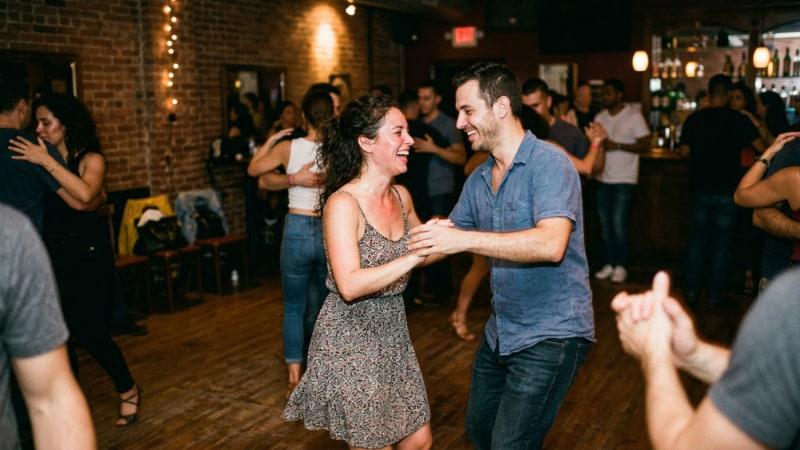
Despite all the benefits of solo training, practicing in isolation quickly reaches its limits as soon as it comes to real partner dance. Social dance styles like Salsa or Bachata thrive on the direct interaction between two people. The interplay of impulse and reaction simply cannot be simulated without a partner. Only through real contact will you learn what the subtle interplay of lead and follow in partner dance feels like.
In a local dance school, you also benefit from immediate correction by experienced teachers. Mistakes that creep in unnoticed during solo training at home are gently corrected here right away. This saves time in the long run and protects you from frustration when the steps suddenly do not work on a real dance floor later on.
That's how it works
Not like this
If you practice the steps at home, you bring the necessary calm into the class. Only in the community does the dance truly come to life.
The choice between your living room and a dance studio does not have to be an either-or. The most successful strategy for aspiring dancers is a combination of both worlds. Use your private time at home to train your coordination, improve your balance, and internalize musical rhythms. This gives you the necessary confidence to fully engage with the dynamics of other people in class.
In a local class, you then get to know the social component of dancing: laughing together over botched moves, quickly adapting to different partners, and the feeling of being part of a vibrant community. Anyone who cleverly combines these two forms of training will quickly build genuine self-confidence and will soon be dancing with joy at every party.
Flexibility and a safe space
You set the pace, choose your own music, and can experiment without any inhibitions. It is perfect for developing an initial feel for your own body and the beat.
Real connection and direct feedback
You practice real interaction with changing partners, receive professional feedback, and experience the motivating energy of a group of like-minded people.
Yes, absolutely. Learning individual dance steps at home helps enormously to get a feel for the rhythm and the basic weight shifts before you enter a dance school.
For the first basics in your living room, normal, comfortable casual clothing is perfectly sufficient. It is best to practice in socks or clean sneakers with the most flexible soles possible.
No, in the vast majority of dance schools and local courses, partners are rotated regularly during class. You can therefore easily sign up without a fixed partner.
As soon as you can perform the absolute basic steps without thinking, it is worth switching to a group. There, you will learn the important skill of reacting to a partner.
Find the right local course and take your steps from the living room to the real dance floor.
 Assess your dance levelBeginner or pro? Learn how to honestly assess your dance level and how to dance with partners at different levels.
 Social Dance Preparation: Your Mindset for the Dance FloorMentally and physically ready for your dance night: This guide shows you how to prepare, ease your nerves, and start with the right mindset.
 Social Dance Clothing & Shoes: The Practical GuideLearn how to choose the perfect social dance clothing and the right shoes for long, carefree nights of dancing so you can feel completely comfortable.Social Dance Preparation: Your Mindset for the Dance FloorMentally and physically ready for your dance night: This guide shows you how to prepare, ease your nerves, and start with the right mindset.
 Muscle memory in dance: How steps become second natureLearn how muscle memory works in dance and how you can automate your steps through targeted training to completely clear your mind.
 Preparing for your first dance night: Relaxed into your first social danceIs your first social dance night coming up? With this guide, you can prepare yourself perfectly, both mentally and organizationally, to ensure your debut on the dance floor is a complete success.
 Common mistakes in learning to dance: 7 mental blocksDiscover the typical mental blocks and false expectations that often unconsciously hold beginners back when learning to dance, and learn how to overcome them.
 Flow in dance: How to completely switch off your mindFlow in dance is the ultimate feeling of ease and connection on the dance floor. Learn how to switch off your mind and reach this state.
 Learning to dance as an introvert: Your guide to social danceDancing without the hustle: How you, as an introverted or shy person, can easily connect with the social dance scene without having to change who you are.
 Don't fear the rejection: Mental approach to dancingDon't fear rejection on the dance floor: Learn how to mentally process a no when dancing and strengthen your self-confidence.