

Experience the dance flow together
On udansa, you connect with like-minded people who want to experience the magic of dance just like you. Find the right courses and dance partners in your area now!

By Bernhard De LucaUpdated

On udansa, you connect with like-minded people who want to experience the magic of dance just like you. Find the right courses and dance partners in your area now!
When the world around you fades away and only the music and the movement remain, you are in the middle of the dance flow. Find out how you can experience this state of effortless ease yourself.
Flow in dance refers to a psychological state of optimal experience, where a dancer is completely immersed in the movement and the music. In this state, the performance unfolds effortlessly and without conscious mental control.
Many people know the feeling of suddenly losing track of time while dancing. The music is playing, the steps work as if by themselves, and your own body moves effortlessly through the room. In psychology, this state is known as flow: a moment of deep happiness in which attention is completely focused on the here and now. In partner dance, this phenomenon gains a very special dimension, as two people engage with the same movement and the same melody at the same time.
To understand flow while dancing, a look at modern cognitive research helps. It is not a spiritual trance or a mystical experience, but a state of optimal brain activity. When the demands of the movement match your own skills exactly, the brain switches into a highly efficient mode. Constant self-control and the evaluation of your own performance fade into the background, creating space for pure intuition.
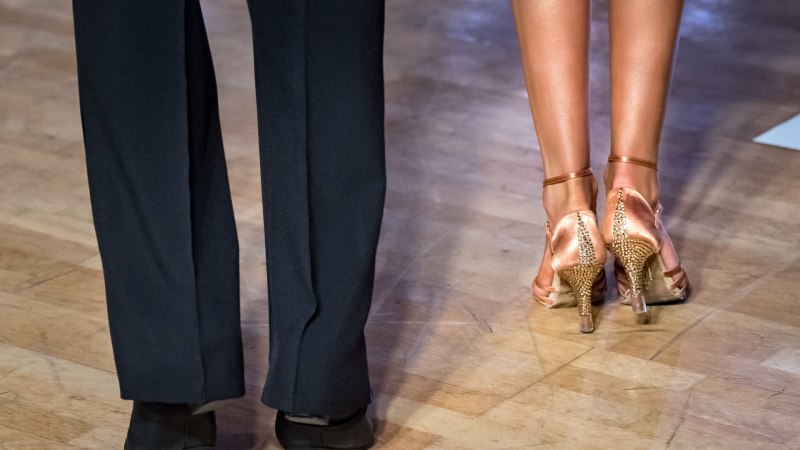
The greatest enemy of dance flow is overthinking on the dance floor. Anyone who desperately tries to recall the perfect sequence of steps or constantly worries about mistakes blocks their natural movement patterns. To be able to switch off your head while dancing, your logical thinking must come to rest to some extent. This succeeds above all when the basic steps are internalized to such an extent that they run without conscious control.
Another key lies in accepting the moment. Instead of evaluating mistakes as failure, in a flow state they are simply accepted as part of the movement and continued creatively. When you learn to let go of control and focus entirely on feeling, you open the door to being able to experience dance flow. This requires some patience, but with the right attitude, the transition from conscious effort to effortless gliding happens almost by itself.
Like this
Don't do this
The magical moment on the dance floor begins exactly when technique fades into the background and the music takes the lead.
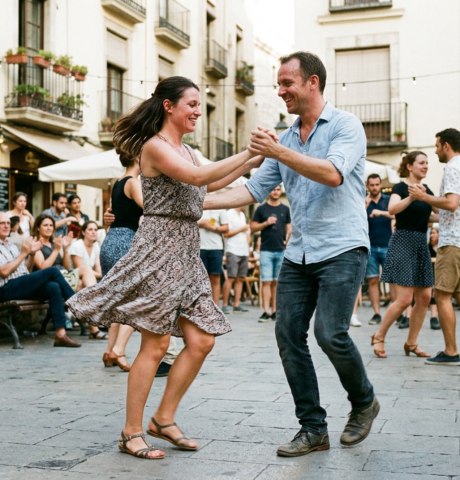
In partner dance, flow is not a solo experience, but a shared moment. When both partners are optimally attuned to each other, an intense flow state in partner dance emerges, where the boundaries between leading and following blur. Communication no longer happens through words, but through subtle impulses, weight shifts, and the shared interpretation of the music. The feeling arises of moving as a single unit.
To build this deep connection, sensitive attunement is necessary. When you engage intensively with the basics of Lead & Follow in partner dance, you create the technical foundation for this intuitive understanding. Only when signals are transmitted clearly and without effort can both partners relax completely and immerse themselves in the music together. The result is an incomparable feeling of lightness on the dance floor.
The foundation of movement
The focus is entirely on the precise execution of steps, learning new figures, and the conscious control of your own body on the dance floor.
The intuitive gliding in the moment
The movement happens intuitively and without thinking. The music guides the body, and the steps flow effortlessly and harmoniously into one another.
Flow in dancing is a psychological state of deep concentration and effortlessness, where you are completely absorbed in the moment. It occurs when the dancing challenge perfectly matches your own skills.
To clear your head, it helps to focus entirely on the music and the physical connection with your partner. As soon as you stop counting your steps in your mind, your subconscious takes over the movement.
Yes, absolute beginners can experience flow if they focus on very simple movements. It is important that the demands do not overwhelm you and that the focus remains on the pure joy of the music.
Sign up now and experience the flow of dancing together at a dance school in your region.
 Assess your dance levelBeginner or pro? Learn how to honestly assess your dance level and how to dance with partners at different levels.
 Lead & Follow: Partner dance as teamworkLeading and following is more than just telling and trailing. Learn how to harmonize perfectly as a leader and follower on the dance floor with udansa!
 Social Dance Preparation: Your Mindset for the Dance FloorMentally and physically ready for your dance night: This guide shows you how to prepare, ease your nerves, and start with the right mindset.
 Learning to dance as an introvert: Your guide to social danceDancing without the hustle: How you, as an introverted or shy person, can easily connect with the social dance scene without having to change who you are.
 Don't fear the rejection: Mental approach to dancingDon't fear rejection on the dance floor: Learn how to mentally process a no when dancing and strengthen your self-confidence.Assess your dance levelBeginner or pro? Learn how to honestly assess your dance level and how to dance with partners at different levels.
 Dance improvisation: 5 exercises for more freedomLearn to move freely to the music without fixed choreography. These five practical exercises will strengthen your improvisation and musicality while dancing.
 Returning to dance after a break: How to succeedStarting to dance again after a long break? With this practical guide, you will reactivate your body awareness and master your return completely stress-free.
 Dance class or dance party: Where do you learn to dance best?Are you choosing between a structured dance class and a free dance party? We compare both paths so you can find the optimal start for yourself.