

Find your dance community at your own pace
On udansa you will find like-minded people who share your passion. Create your profile and discover dance partners, courses, and events in your area, completely without pressure.

By Bernhard De LucaUpdated

On udansa you will find like-minded people who share your passion. Create your profile and discover dance partners, courses, and events in your area, completely without pressure.
You love music and movement, but shy away from the hustle and bustle of large dance floors? Don't worry: the dance scene offers wonderful niches, especially for sensitive and observant people, to arrive without the need for loud words.
Introversion describes a personality trait where people draw their energy from their inner world and quiet moments, while social interactions in large groups drain it.
The idea of stepping onto a crowded dance floor and approaching strangers triggers a flight reflex in many rather than anticipation. However, the assumption that social dance is only for extroverted show-offs is too simplistic. Those who are more quiet and observant bring excellent prerequisites for partner dancing. Introverted people often possess a keen perception and the ability to focus deeply on a partner, two core competencies for a harmonious connection while dancing.
To arrive in the scene, you do not have to bend over backwards or suddenly become a small talk pro. The key lies in using your own strengths in a targeted way and shaping your entry so that it conserves your own energy reserves. A structured framework like a fixed course makes contact much easier, as the procedures are clearly defined and interaction happens quite naturally through movement.

Getting started is easiest when you take the pressure off yourself to shine at big parties right away. Instead, use the protected atmosphere of dance schools. In regular courses, the barrier to entry is low because everyone present is there to learn. If you want to specifically approach social dance as a beginner with anxiety, small, manageable groups help to build confidence.
A proven path for introverts is to attend the offered taster sessions, often called "drop-in classes," before the actual dance parties. There you will meet other beginners, the structure is clear, and you are already in the room before it gets really crowded. This gives you time to get used to the acoustics and the environment without being directly in the spotlight. As soon as the open party begins, you already have the first familiar faces around you.
How to succeed
What's holding you back
The best dancers are often those who are quiet in everyday life. They listen more closely to the music and their partner, which makes their dancing incredibly intense.
If you are shy, you often worry about how you come across to others or how to elegantly phrase an invitation. The good news: in social dance, the movement speaks for itself. Friendly eye contact and a simple, quiet "Would you like to dance?" are completely sufficient. On the dance floor itself, there is hardly any room for deep conversations anyway, which is a huge relief for introverts.
To ensure you don't lose the fun in the long run, you should respect your boundaries. Social dancing is intense and processes many stimuli at the same time: music, light, physical contact, and navigation in the room. It is perfectly legitimate to take a break after a few dances, sit on the sidelines with a drink, and just watch. Many dancers use these breaks to absorb the energy in the room without being active themselves. This way, you remain part of the action while recharging your batteries at the same time.
The strength of subtle tones
You use your powers of observation to pick up on the mood on the dance floor. You focus entirely on the subtle signals from your dance partner and dance precisely, sensitively, and with high attention to the details of leading.
The power of external impact
You are looking for interaction with the entire group, you switch partners quickly and you love the hustle and bustle. You draw your energy from the dynamics of the room and the constant, lively exchange with many different people.
Yes, absolutely. Partner dance is about non-verbal communication and subtle sensing. Many introverts are excellent dancers because they can focus particularly well on their partner without being distracted by external stimuli.
Find a fixed spot near the dance floor and maintain eye contact with those passing by. An open, attentive posture signals that you are ready to dance, without you having to actively approach anyone. A slight smile also works wonders.
Set time limits for yourself and leave the party when your energy is depleted. You do not have to stay until the end to belong. Short breaks for fresh air or a quiet moment at the bar also help with recharging.
Discover courses that match your pace, and meet nice people in a relaxed atmosphere.
 Assess your dance levelBeginner or pro? Learn how to honestly assess your dance level and how to dance with partners at different levels.
 Social Dance Preparation: Your Mindset for the Dance FloorMentally and physically ready for your dance night: This guide shows you how to prepare, ease your nerves, and start with the right mindset.Social Dance Preparation: Your Mindset for the Dance FloorMentally and physically ready for your dance night: This guide shows you how to prepare, ease your nerves, and start with the right mindset.
 Don't fear the rejection: Mental approach to dancingDon't fear rejection on the dance floor: Learn how to mentally process a no when dancing and strengthen your self-confidence.Assess your dance levelBeginner or pro? Learn how to honestly assess your dance level and how to dance with partners at different levels.
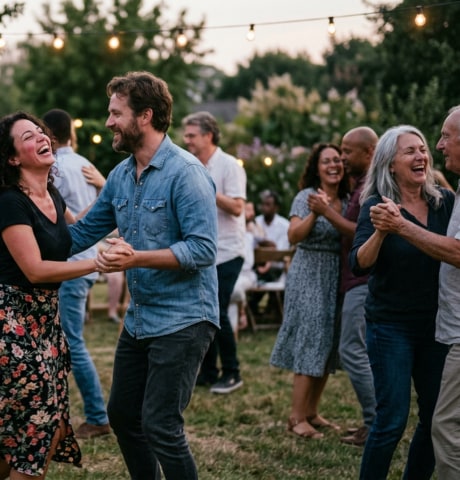 Dance improvisation: 5 exercises for more freedomLearn to move freely to the music without fixed choreography. These five practical exercises will strengthen your improvisation and musicality while dancing.
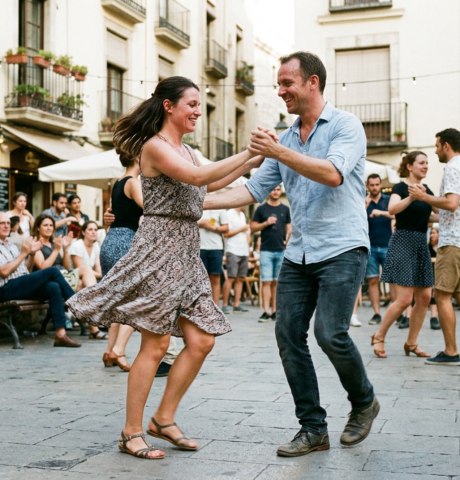 Returning to dance after a break: How to succeedStarting to dance again after a long break? With this practical guide, you will reactivate your body awareness and master your return completely stress-free.
 Dance class or dance party: Where do you learn to dance best?Are you choosing between a structured dance class and a free dance party? We compare both paths so you can find the optimal start for yourself.
 Dance Night Checklist: Ready for your first social danceThe quick last-minute check before you leave the house. With this compact checklist for your dance night, you are guaranteed not to forget anything important.