Dancing in harmony together
Find dance partners for Forró, Kizomba, and other partner dances on udansa, or discover suitable courses and dance evenings right in your area.

By Bernhard De LucaUpdated
Find dance partners for Forró, Kizomba, and other partner dances on udansa, or discover suitable courses and dance evenings right in your area.
Forró and Kizomba thrive on an embrace that has become rare in everyday life. Why genuine respect and clear agreements are the prerequisites for close-contact partner dance to succeed effortlessly.
Social dance refers to partner dances that are danced purely for social enjoyment at dance evenings, without judges or fixed choreographies. The dance partner usually changes after a few songs.
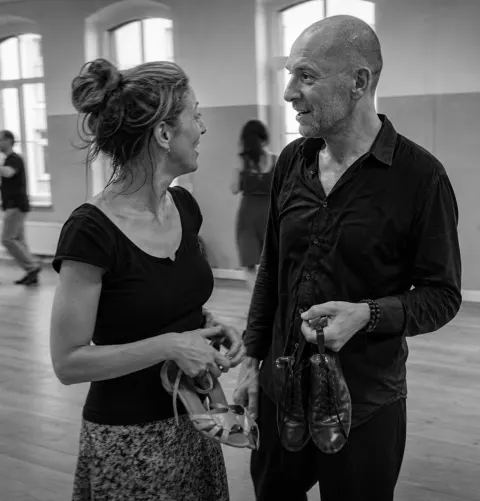
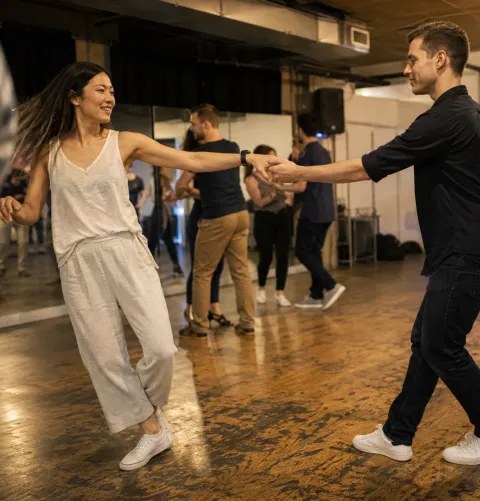
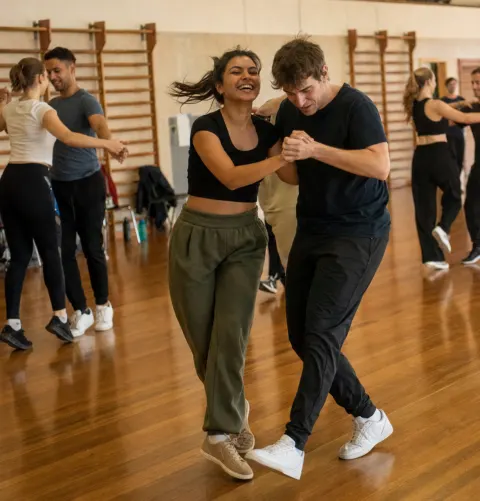
Anyone visiting a dance evening for the first time often finds Forró and Kizomba a surprise: dance couples move chest to chest, faces almost touching, and the steps flow in a shared pulse. The Forró scene in Leipzig is characterized by a culture that defines close-embrace couple dances through mindfulness and respect from the very beginning. Physical closeness in dance is not a flirtation, but a tool for non-verbal leading. When two bodies stand close together, the smallest shifts in weight in the upper body become immediately perceptible. This makes complicated hand movements unnecessary and allows for fine, almost weightless communication.
For beginners, this small distance feels unusual at first. Our everyday world demands a personal distance zone of at least one arm's length, which is consciously suspended in social dance. This only works on the dance floor because a tacit framework applies: the physical connection serves exclusively for moving together to the music. Anyone looking for connections in Leipzig will quickly find people through socials and courses who have internalized this code. When looking for suitable contacts, a look at specialized offers also helps to start your own search for a dance partner in a targeted manner.

The biggest hurdle for newcomers is rarely the rhythm, but rather the concern for their own boundaries. In the Kizomba community in Leipzig, as well as with Forró, an unwritten principle applies: the dance posture is always determined by the person who needs more space. No one has to be forced into a closed embrace. An open posture, where there is a hand's breadth of space between the partners and contact is maintained primarily through the hand and forearm, is legitimate and technically complete at all times.
A considerate leader gently tests the desired distance in the first few bars and senses whether the follower gives way or builds up gentle counter-pressure. A gentle withdrawal is not a mistake, but a signal that is respected immediately. In addition, clear verbal agreements before the dance help: a brief mention of a tense shoulder or the desire for a looser posture immediately creates relaxation on both sides. Many dancers also know such situations from other dances like Tango, where historical ballrooms or milongas cultivate similarly clear codes of conduct.
How to handle closeness successfully
Common mistakes
Find the right course for your favorite dance right in your area.
Real dance connection is not created by holding on, but by the mutual agreement to give each other exactly the space that is needed.
Social dancing thrives on spontaneity, but community is built where people feel comfortable in the long term. Anyone looking for a Forró dance partner in Leipzig or wanting to dive into the Afro-Latin scene quickly learns that hygiene, courtesy, and equality are the pillars of every successful evening. A fresh change of shirt, deodorant, and mints are standard items in an experienced dancer's bag, as the close dance hold makes odors and sweat immediately noticeable.
Equally important is the certainty that a dance does not mean an obligation for the entire evening. Traditionally, you dance one or two songs together and then thank each other kindly. A dance invitation can be declined at any time without giving a reason, without causing any hard feelings. If you are new in town or want to expand your repertoire, you can find connections through Brazilian dance and compare experiences from other scenes. With curiosity, consideration, and a keen sense for your partner, moving together becomes an intense, liberating dialogue.
Safety and overview for beginners
Offers maximum comfort for beginners and leaves room to breathe. Leading is controlled via hand hold and shoulder contact, which makes orientation in the room easy.
Direct transmission of the smallest impulses
Requires mutual trust and fine contact at the upper body. Turns and weight shifts are transmitted without delay directly from the center.
No, you do not have to pull anyone close to you or lean in. An open posture with a hand's breadth of distance is completely accepted and technically equivalent in every class and at every social.
Fresh clothes, deodorant without an overpowering scent, and mints are the most important tools for close social dances. It is best to bring a spare top in case the evening gets sweaty.
A short, friendly no thank you is perfectly sufficient. In social dancing, it is common and socially accepted to decline an invitation without an explanation.
 Find a dance partner in Leipzig for courses, clubs, and balls
 Trial dance in Leipzig: Find a dance partner without mistakes
 Tanzarchiv Leipzig: GDR Dance History at the University Library
 Tango Community Leipzig: Contacts and Milonga Networks
 Find a dance partner for Ballroom and Latin in Leipzig
 Find a Salsa dance partner in Leipzig: step by step
 Dance partner wanted in Leipzig: The path to the perfect dance couple