Sweep across the dance floor together
On udansa you can find dance partners for Ballroom and Latin as well as an overview of current dance courses and open dance parties in Leipzig.

By Mary De LucaUpdated
On udansa you can find dance partners for Ballroom and Latin as well as an overview of current dance courses and open dance parties in Leipzig.
Social dancing at a gala requires a different sensibility than training in the protected environment of a dance class. Anyone who understands floor dynamics moves confidently across any dance floor.
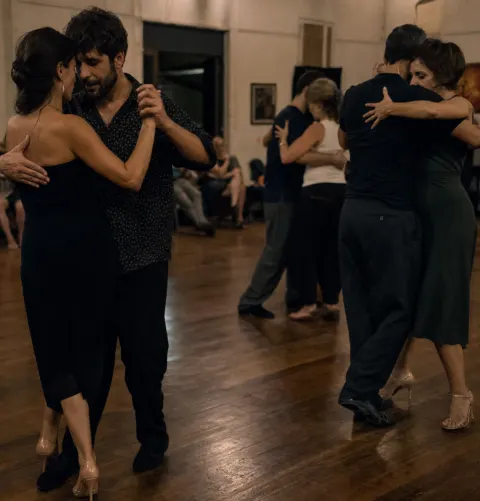
Dance direction refers to the mandatory path of movement in the hall, where couples in traveling dances move counter-clockwise along the outer edges. It prevents collisions during dynamic step sequences.
A Ballroom Latin dance party in Leipzig differs fundamentally from a regular lesson. While the focus in a dance class is on learning new figure sequences and precise footwork, the free dance evening serves as a casual way to try out your own repertoire. No one corrects your posture or counts the beat out loud. You decide together with your partner which figures you want to dance and when you want to take a break.
For many couples, free dancing is the most important step to gain routine in ballroom dancing. Changes in music challenge your hearing, and the presence of other couples trains spatial orientation far more than any isolated practice session. If you want to go ballroom dancing in Leipzig, you will find opportunities for classic partner dances in traditional venues like the Felsenkeller on Karl-Heine-Straße or at festive occasions like the Leipzig Opera Ball, but casual dance evenings without a course commitment also offer the ideal floor for this. The most important thing is a relaxed attitude: a dance party is not about flawless perfection, but about the shared rhythm.

On a dance floor where both space-consuming ballroom dances and stationary Latin dances are performed simultaneously, unrest quickly arises if the unwritten rules of the room are ignored. The most important principle is the so-called line of dance: for traveling dances like Waltz, Viennese Waltz, Quickstep, or Tango, the entire field moves counter-clockwise along the outer edge of the room. Anyone who understands this system avoids collisions and can glide across the floor in a relaxed manner.
The dance floor is divided into two zones:
If you are new to a ballroom dance party in Leipzig, it is best to observe the flow for a moment before entering the dance floor. An attentive look at the other couples helps to time your entry at the edge safely.
That's how it's done
Don't do this
Find suitable courses and workshops to refine your steps before the next party.
At a dance party, it is not the flawless posture from the textbook that counts, but the ability to react flexibly to the music and the space around you.
A successful ballroom and Latin dance party thrives on mutual consideration. When the floor gets crowded, experienced dancers automatically shorten their steps. It is considered impolite to force expansive poses or wide throwing figures in tight spaces, which could endanger other couples. The leader takes responsibility for protecting both dancers here: they keep an eye on the space behind the follower and steer the couple out of danger zones in time.
Should a slight bump occur, a quick smile and a friendly apology are good manners, regardless of who caused the situation. Anyone who regularly enjoys partner dancing in Leipzig at a dance party appreciates exactly this relaxed atmosphere. If you want to get back into it after a long break or refresh your skills before the next big ball, the corresponding balls in Leipzig also offer a festive goal for which free practice pays off.
For Waltz, Tango and Quickstep
Couples move continuously counter-clockwise along the outer track. Here, continuous momentum, anticipating obstacles, and a clear sense of space are what count.
For Rumba, Cha-Cha and Jive
In the center of the room, couples largely stay in place. Here, figure sequences of Rumba, Cha-Cha or Samba are danced cleanly without any forward momentum.
No, for most open dance parties and social dances you do not need a club membership. You usually just pay a guest fee at the door and can start dancing right away.
Shoes with smooth leather soles or special chrome leather soles are ideal, as they allow for smooth turning on wood. Street shoes with rubber soles stop too abruptly and can put strain on your joints.
Smart casual or elegant attire is appropriate, as long as it allows for freedom of movement. Fabrics that are too warm are impractical, as you warm up quickly on the dance floor.
Yes, at many social dance formats it is common to come without a fixed partner and ask different people to dance on the spot. If you are specifically looking for someone, you can connect with others on udansa in advance.
 Go dancing in Leipzig: Social dance, dance parties, and milongas
 Clubs in Leipzig: Dancing between Distillery, Conne Island and Werk 2
 Ballrooms in Leipzig: Historic venues from Felsenkeller to Schaubühne
 Leipzig Opera Ball: A night at the Opera House on Augustusplatz
 Dancing at Wave-Gotik-Treffen: Dance culture and floors at WGT Leipzig
 Going dancing in Leipzig on Saturday: What matters when choosing a venue
 Balls in Leipzig: A Guide to Glamorous Galas