
Sharing Samba experiences makes you happy
Find like-minded Samba enthusiasts on udansa who, just like you, want to polish their technique or train together in a group.



By Mary De LucaUpdated
Find like-minded Samba enthusiasts on udansa who, just like you, want to polish their technique or train together in a group.
Samba no Pé radiates energy and joy of life, but the extremely fast footwork does not forgive any technical inaccuracies. If you recognize typical movement errors early on, you protect your joints and dance more elegantly right away.
Influence on balance
The errors are sorted according to their impact on physical balance and the risk of injury.
Relevance for high speed
Only technical errors that directly block the achievement of high speed were taken into account.
Practical relevance
The selection is based on the most frequently observed mistakes in dance schools and training rooms.
Independent review
Nobody has paid for a placement or mention on this list.

Mistake 1: Weight on your heels
If you shift your weight onto your heels, you will feel stuck to the floor. For fast Samba no Pé, your weight must be entirely on the balls of your feet to allow for the necessary agility and speed.
Mistake 2: Locked knees
Many beginners try to rotate their hips in isolation without moving their knees. However, the typical Samba hip movement is created purely mechanically by alternately bending and straightening the knee joints.
Mistake 3: Leaning the upper body backwards
An upper body leaning backwards throws your center of gravity off balance. To maintain your balance and give your feet the necessary freedom, your upper body must be tilted slightly forward.
Mistake 4: Uncontrolled arms
If you move your arms completely without control, you lose stability in your core. Your arms should support the rhythm of your legs, instead of leading a restless life of their own.
Mistake 5: Flat two-beat instead of three-beat
Samba no Pé is based on a clear three-step rhythm. If you leave out the quick intermediate step (the "bounce") and walk flat in a two-beat rhythm instead, you lose the typical Samba character.
Mistake 6: Shoulders pulled up
Tense shoulders and a stiff neck block the entire flow of movement. Only a relaxed upper body allows the hips to react softly and rhythmically to the knee work.
Mistake 7: Looking at the floor
If you stare rigidly at your own feet while dancing, you lose your orientation in the room and your proud appearance. Your gaze should be directed forward to ensure presence and balance.
Anyone who knows the typical pitfalls of fast Samba no Pé can adjust their training accordingly. The ranking clearly shows that the most serious mistakes are not due to a lack of speed, but to incorrect weight distribution and a blocked hip. If the foundation is not right, even the fastest foot tapping is useless. Only when the weight consistently remains on the ball of the foot and the pelvis leads the movement does the typical, springy Samba bounce emerge, which makes the dance look so effortless.
To effectively correct these mistakes in solo training, looking in the mirror or recording a video of your own footwork often helps. Many dancers try to create the hip movement artificially instead of letting it arise from the natural bending and stretching of the knees. Anyone who wants to build the basics of Samba no Pé systematically will find a detailed guide for getting started in the article on dancing Samba solo.
You can tell that your weight distribution is incorrect if you constantly fall out of rhythm at a fast tempo or lose your balance. If your heels are firmly touching the floor, you are blocking your own dynamics.
Yes, a blocked hip is almost always due to knees that are too stiff. The hip movement in Samba no Pé is not an active circling, but the result of the rhythmic bending and stretching of your knee joints.
Film yourself dancing from the front and from the side. When watching the video, you will immediately see if your arms are swinging uncontrollably or if your upper body is tilted too far back.
Find the right course to improve your technique under professional guidance.
BallroomMeißen · Germany
Tanzkreis | PROFESSIONALTuesday · 20:15 · Oct 27, 2026 - Jan 5, 2027
“Ein Haus für Vieles” - Saal Tanzkurse
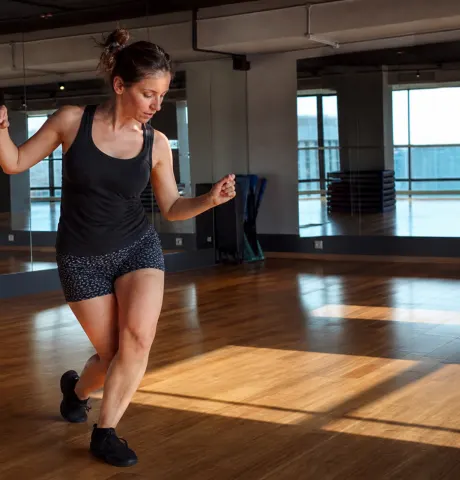 Dancing Samba solo: The guide for Samba no Pé and show danceDancing Samba solo brings the pure joy of life from Brazil directly to you. Learn everything about the technique of Samba no Pé and how to master the carnival dance.
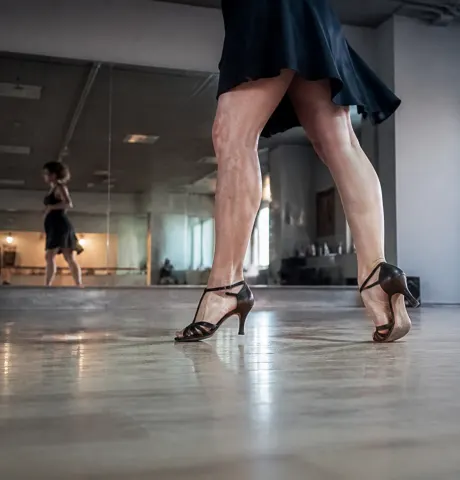 Samba Passista Test: What is your solo level?Ready for the carnival stage? Take the samba passista test and find out how good your Samba no Pé really is.
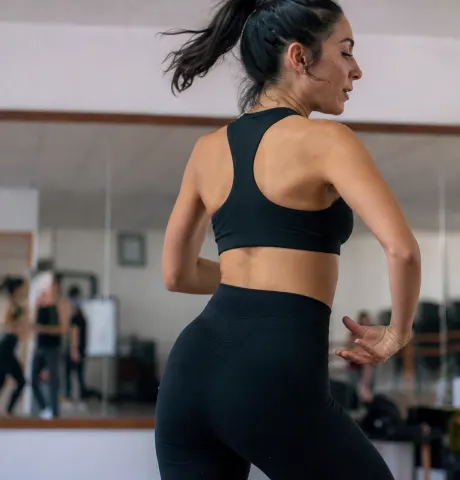 Learn Samba hip movement: Technique for solo dancersDiscover the secrets of Brazilian Samba hip technique. This guide shows you how to move your pelvis independently and master the signature Samba wave with targeted isolation exercises.
 Samba arm movements: Guide to elegant stylingBring elegance to your solo dance. Our guide shows you step by step how to perfectly coordinate your arm movements and dance with style in Samba no Pé.
 Samba Carnival Rio Trends: The Evolution of PassistasThe carnival in Rio de Janeiro is constantly reinventing itself. Learn how modern passistas are revolutionizing the samba runway with innovative costumes and urban dance styles.
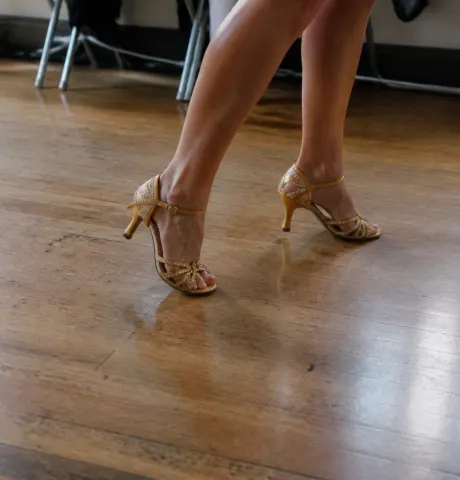 Samba solo dance shoes: The best heels for CarnivalThe right shoe makes the difference between brilliance and pain during Samba no Pé. Learn in our guide how to choose the perfect Samba heels for Carnival.
 Samba Solo Warm-up: Guide for home trainingPrepare your body optimally for the fast pace of this Brazilian solo dance. This structured warm-up guide protects your joints and activates your muscles for training at home.