Take the next step together
Find suitable dance partners for Argentine Tango or discover current courses and milongas right in your area.

By Bernhard De LucaUpdated
Find suitable dance partners for Argentine Tango or discover current courses and milongas right in your area.
In Argentine Tango, every step is created in the moment: Learn how the dance culture works at a milonga and what matters when getting started in Leipzig.
A milonga refers to both the traditional dance event for Argentine Tango and an independent, faster music and dance genre. At the event, couples dance to tandas and use rituals such as eye contact to invite one another to dance.
Anyone entering a room where Tango is danced for the first time in Leipzig immediately notices the special atmosphere. Unlike fixed choreographies in ballroom dancing, Argentine Tango is based entirely on non-verbal improvisation. In Leipzig, there are several weekly milongas and prácticas that enable exactly this exchange. A well-known meeting point for dancers is the Wasserhäuschen in the Plagwitz district, where regular evenings take place. A dedicated regional calendar also provides an overview of dance opportunities, bundling dates for Leipzig and all of Central Germany.
A common misconception among beginners is the assumption that Tango Argentino consists of fixed step patterns that one only needs to memorize. In reality, lessons primarily teach body awareness, weight shifting on one's own axis, and a sensitive connection within the pair. Those who want to learn Tango therefore rarely start with complicated figures, but rather with walking together to the music.
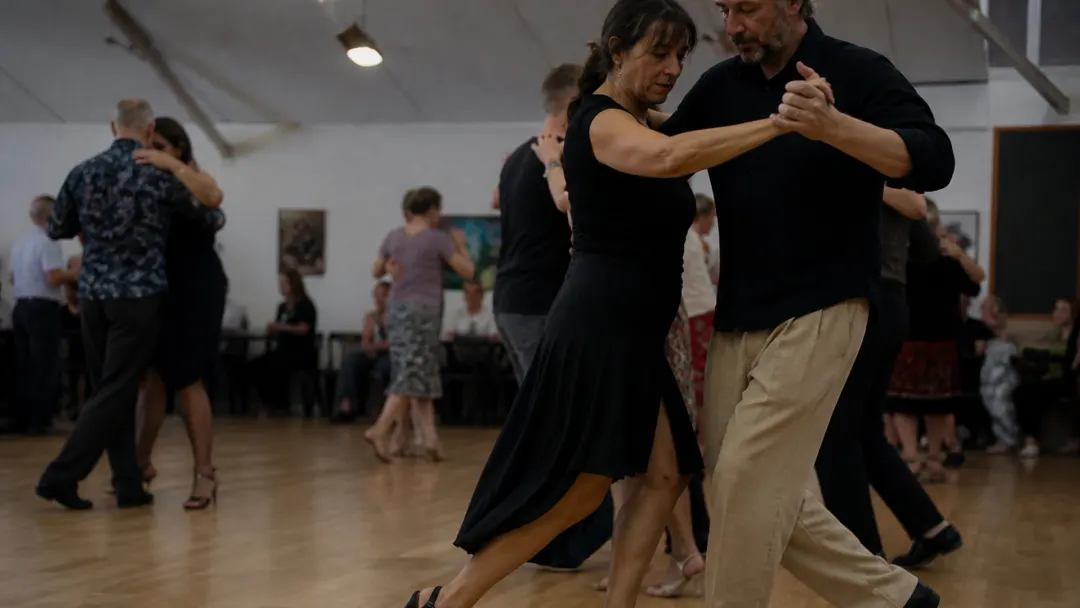
The social dance evening in tango follows its own, historically grown rules, the so-called códigos. They do not serve to intimidate newcomers, but rather create a protected space for everyone involved. The music is traditionally played in tandas: blocks of three to four songs by the same orchestra, which are interrupted by a short cortina. This transition music signals the end of the dance and allows both partners to politely say thank you and leave the dance floor.
A central component of this culture is the invitation via eye contact, the so-called cabeceo. Instead of walking across the room and approaching someone directly at their table, dancers seek eye contact over a certain distance. Only when a confirming nod is given does the leading person head to the dance floor. If the gaze is averted, it is considered a discreet refusal without loss of face. Anyone who is enthusiastic about Argentine Tango will quickly realize how relaxed this process makes social interaction on the dance floor.
Like this
Don't do this
Find suitable Tango courses and workshops for your level in Leipzig.
In Tango, two bodies speak with each other, without a single word needing to be said. The true art lies in listening attentively.
On the dance floor, all couples move counter-clockwise in concentric lanes, the so-called ronda. Since couples of different experience levels dance together, the leading role bears the responsibility for the space ahead, while the following person trusts not to be led backwards into obstacles. Large lifts or wide kicks belong on show stages, such as at the Leipzig Ballet, but have no place on a crowded milonga.
For learners, we recommend attending prácticas in addition to regular course attendance. In this casual setting, you can stop the music, discuss movement sequences, and try out role distribution without the pressure of etiquette. Once you have internalized the basics of axis and connection, you will also find your way around tradition-conscious dance evenings with confidence.
The learning space for technique and exchange
The Práctica offers a relaxed practice space. Here, you are welcome to talk, experiment, correct, and interrupt the sequence of steps at any time.
The social highlight of Argentine Tango
The Milonga is the traditional social evening. You dance in the flow of the music without verbal corrections, supported by established rituals.
For the beginning, comfortable shoes with a smooth leather sole that make turning on the ball of the foot easier are sufficient. Special Tango shoes offer additional stability and flexibility later on, but they are by no means mandatory for trial lessons.
No, Argentine Tango is usually taught in courses with rotating partners to learn leading and following independently of one fixed person. Prácticas and dance exchanges also offer good opportunities to meet new dance partners.
At a milonga, you usually dance a complete tanda of three to four songs with the same person. Only when the cortina plays do you thank each other and leave the dance floor together.
 Dance styles in Leipzig: How to find the right dance for you
 Lindy Hop Leipzig: How to get started with swing
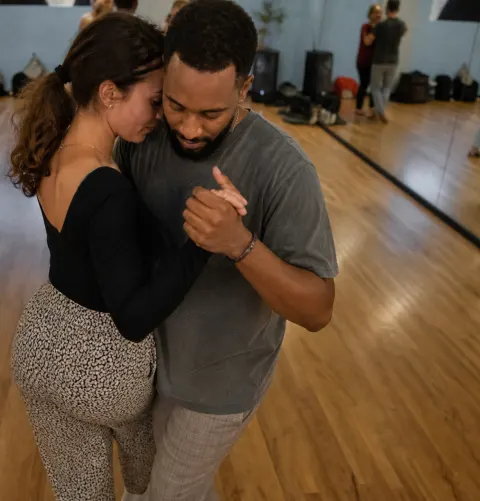 Kizomba in Leipzig: Your guide to Urban Kiz and Semba
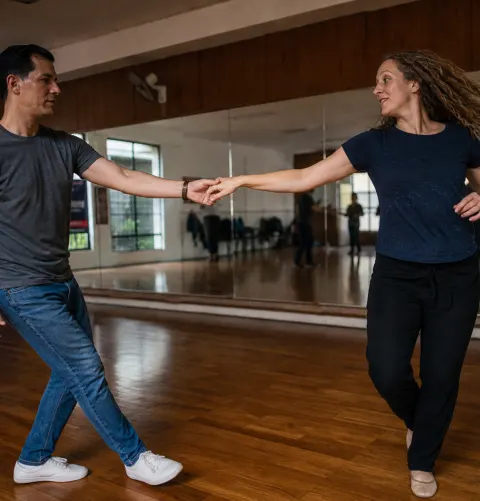 West Coast Swing in Leipzig: Focus on modern partner dance
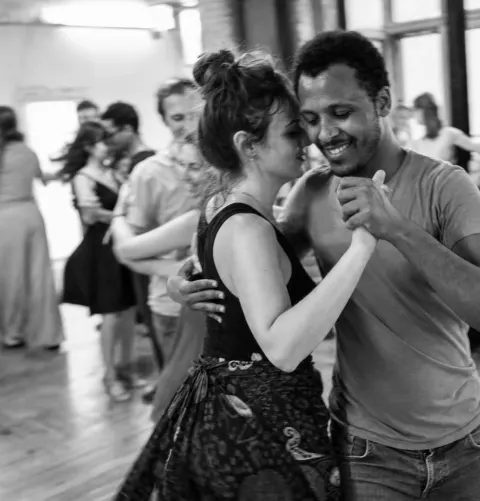 Forró in Leipzig: Experience Brazilian Joy of Life
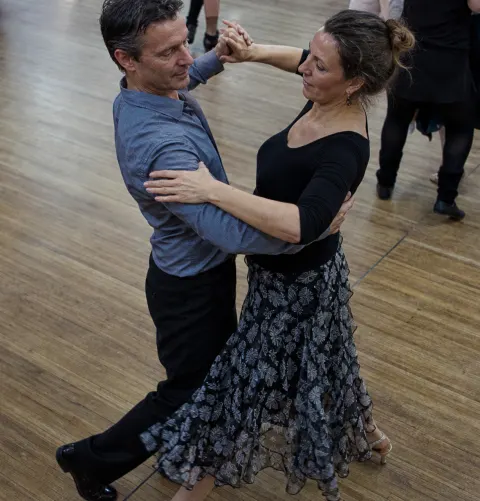 Ballroom dancing in Leipzig: Waltz, dance frame and technique
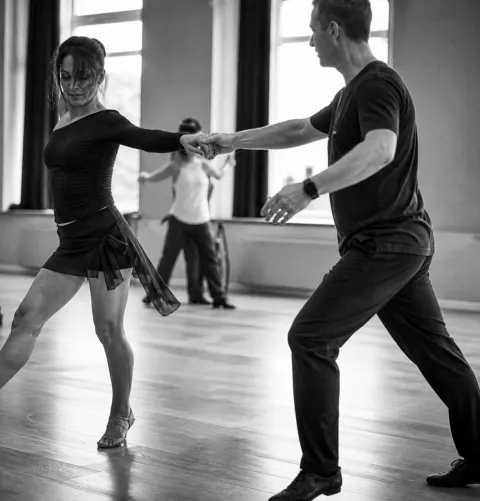 Latin American dances in Leipzig: Cha-Cha, Rumba and Jive